You Only Need a Few Funds: Building a World-Class Portfolio with 4–8 Index Funds
The investing industry has a habit of making things look more complicated than they need to be.
Dozens of funds. Layers of strategies. Complex alternatives. Tactical overlays.
It creates the impression that better results require more moving parts.
The reality is the opposite.
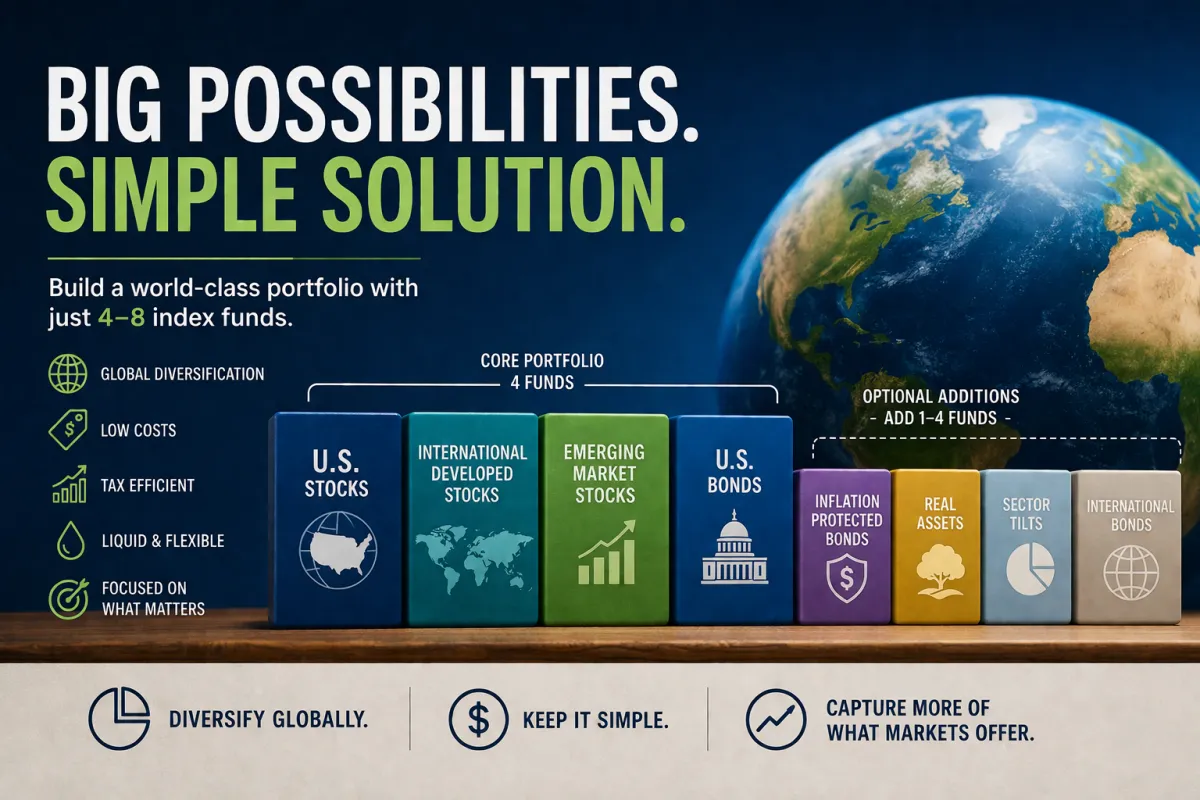
You can build a highly sophisticated, globally diversified portfolio using just 4 to 8 index funds. And in many cases, that simplicity is not just sufficient. It is superior.
The Case for Simplicity
Let’s start with what the data actually shows.
Decades of research have made one thing clear. Asset allocation drives the vast majority of portfolio outcomes. The foundational work by Brinson, Hood, and Beebower demonstrated that over 90 percent of the variation in portfolio returns is explained by asset allocation decisions.
Follow-up research by Ibbotson and Kaplan reinforced the conclusion. Asset allocation explains nearly all of the level of returns over time, even if differences between managers exist at the margin.
There is an important implication here.
You do not need complexity to capture these results.
A small number of broad asset classes gets you most of the way there.
What 4–8 Funds Actually Gets You
A well-constructed portfolio with just a handful of index funds can cover the vast majority of the global investment universe.
At the core, you only need a few building blocks:
U.S. equities
International developed equities
Emerging markets equities
U.S. bonds
That is four funds.
With those four exposures alone, you gain access to:
Thousands of companies across the global economy
Multiple economic regimes and growth cycles
Currency diversification
A balance between growth and stability
From there, you can add optional exposures to further refine the portfolio:
Inflation protected bonds
Real assets such as commodities or REITs
Sector funds for targeted tilts
International bonds if desired
Even with these additions, you are still well within the 4 to 8 fund range.
The key insight is simple.
Diversification comes from exposure, not from the number of line items in your portfolio.
Expressing a View Without Complexity
One of the biggest misconceptions in investing is that index funds eliminate flexibility.
In reality, they give you cleaner control.
With just a few funds, you can express meaningful investment views.
If you believe the U.S. market is expensive, you can tilt toward international equities.
If you see long-term growth in emerging markets, you can increase that allocation.
If you want to emphasize innovation, you can add a technology sector fund.
If you are concerned about inflation, you can increase exposure to real assets or possibly inflation-protected bonds.
Each of these decisions requires only one additional fund.
You are not outsourcing your thinking to a manager. You are directly shaping the portfolio.
That is a more powerful approach.
The Hidden Advantage: Tax Efficiency
Simplicity does more than reduce complexity. It improves outcomes.
One of the most important benefits is tax efficiency.
Index funds are designed to track markets, not trade them aggressively. That means low turnover and fewer realized capital gains.
Compare that to more complex portfolios, which often include:
Active managers trading frequently
Layered strategies that generate short-term gains
Illiquid investments with unpredictable tax consequences
Each of these creates friction.
Over time, that friction compounds into meaningful underperformance.
A simple index-based portfolio allows you to:
Defer capital gains
Control when taxable events occur
Harvest losses more efficiently
Maintain cleaner, more predictable after-tax results
For taxable investors, this is a major advantage.
Liquidity Is a Feature, Not a Footnote
Liquidity is often overlooked when portfolios are being designed.
It should not be.
Public index funds provide daily liquidity. You can rebalance, adjust exposures, or raise cash at any time.
That flexibility gives you control.
Many complex portfolios sacrifice this advantage. Private investments, interval funds, and structured products can limit access to capital or delay redemptions.
That can create problems at exactly the wrong time.
A simple, liquid portfolio avoids those risks entirely.
It gives you both exposure and flexibility.
Costs Compound in Reverse
If asset allocation is the main driver of returns, then costs are the most reliable way to lose them.
Every dollar paid in fees is a dollar that no longer compounds.
This is not theoretical. It is arithmetic.
Research has shown that differences in fees can lead to dramatically different outcomes over long time horizons.
A portfolio earning 7 percent before fees and 5.5 percent after fees will produce vastly different results over 20 or 30 years.
High-cost products often hide inside otherwise reasonable allocations. The structure looks sound, but the implementation erodes returns.
Index funds solve this problem directly.
They provide broad exposure at minimal cost.
They remove layers of fees.
They allow more of the market return to reach the investor.
Why Simpler Portfolios Often Perform Better
There is also a behavioral edge to simplicity.
Simple portfolios are easier to understand and easier to maintain.
That matters more than most investors think.
Complex portfolios create more opportunities for doubt. More decisions. More second-guessing.
That often leads to poor timing decisions, which are one of the biggest drivers of underperformance.
A simpler structure reduces that risk.
It helps investors stay disciplined.
There is a growing body of evidence that investor behavior plays a significant role in realized returns. A portfolio that an investor can stick with often outperforms a more complex strategy that they abandon.
Simplicity increases the odds of staying invested.
Capturing the World’s Returns
The goal of investing is not to find something magical.
It is to capture what already exists.
Global equity markets provide growth.
Fixed income provides stability and income.
Diversifying assets provide balance across different environments.
A portfolio of 4 to 8 index funds allows you to capture these return streams efficiently.
You are not trying to outguess the market.
You are ensuring that you participate in it.
And when you combine:
Thoughtful asset allocation
Broad diversification
Low costs
Tax efficiency
Liquidity
You create a portfolio that is designed to succeed over time.
What This Looks Like in Practice
A practical portfolio might look like this:
Total U.S. stock market fund
International developed markets fund
Emerging markets fund
U.S. aggregate bond fund
Short-term treasury fund
Optional additions could include:
Real assets or REIT exposure
A sector fund for targeted tilts
International bonds for additional diversification
Commodity exposure
With five to eight funds, you have built a portfolio that captures the vast majority of global investment opportunities.
There is very little you are missing.
And importantly, there is very little unnecessary complexity.
The Tradeoff Most Investors Miss
Complexity feels sophisticated.
But in investing, complexity often introduces new risks:
Higher costs
Lower transparency
Reduced liquidity
Behavioral mistakes
Simplicity removes those risks.
It allows the core drivers of returns to come through.
It aligns your portfolio with what the evidence supports.
The ArcVest Perspective
At ArcVest, we believe that great portfolios are built on clarity, not complexity.
A small number of well-chosen index funds can provide exposure to the global economy in a way that is efficient, transparent, and repeatable.
You do not need dozens of strategies.
You need the right structure.
When you focus on asset allocation, keep costs low, and maintain discipline, you capture what markets are designed to deliver.
That is the real advantage.
That is where the alpha comes from.
