The Only Alpha That Matters: Asset Allocation
Investors spend an extraordinary amount of time chasing alpha. They search for the next great manager, the next outperforming stock, or the next tactical edge. But decades of research point to a much simpler truth.
The primary driver of portfolio outcomes is not stock picking. It is not market timing. It is not access to exclusive funds.
It is asset allocation.
Once you understand this, investing becomes both simpler and more powerful. You stop searching for magic and start focusing on what actually works.
The Data Is Clear
The most widely cited research in portfolio management comes from the landmark 1986 study by Brinson, Hood, and Beebower. Their conclusion has echoed through the industry for decades.
Asset allocation explains the vast majority of portfolio behavior.
Depending on how it is measured, asset allocation has been shown to explain over 90 percent of the variation in portfolio returns.
That number is often misunderstood, so let’s clarify it.
The study showed that the mix of stocks, bonds, and other asset classes drives the bulk of how a portfolio behaves over time. In other words, your returns are largely determined by what you own, not which specific securities you pick.
Later research by Ibbotson and Kaplan refined the conclusion. They found that asset allocation explains nearly all of the level of returns over time, even if differences between managers can exist at the margin.
The takeaway is straightforward.
If you get asset allocation right, you have already done most of the work.
Why Asset Allocation Dominates
At its core, investing is about exposure.
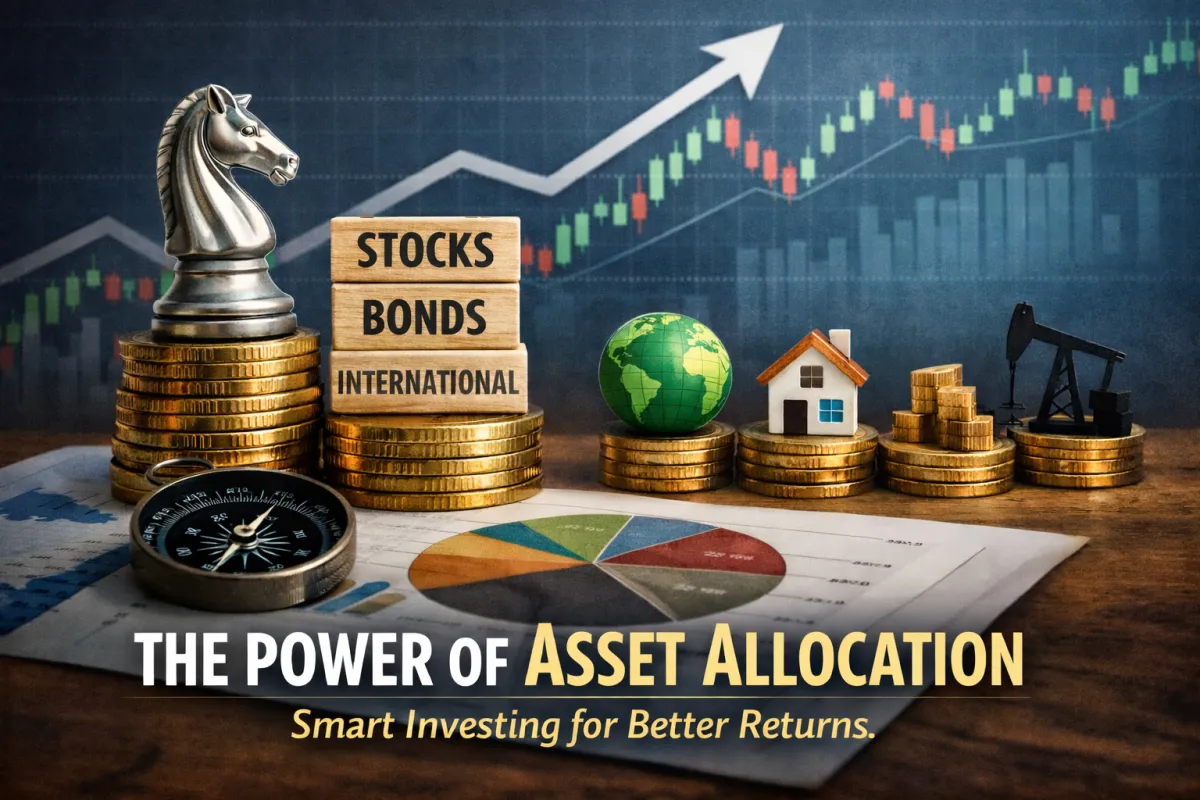
Equities generate long term growth. Bonds provide stability and income. Real assets hedge inflation. International exposure adds diversification.
Each asset class carries its own expected return, risk profile, and economic sensitivity. When you combine them, you are building the engine that drives your portfolio.
A simple example makes this clear.
A portfolio that is 80 percent equities and 20 percent bonds will behave very differently from one that is 40 percent equities and 60 percent bonds. Over time, that difference will overwhelm any incremental gains from picking the “right” stocks or funds.
Even in portfolios that use active managers, research shows that roughly 80 to 90 percent of returns still come from asset allocation rather than manager skill.
That should reframe how you think about investing.
Manager selection is a second order decision. Asset allocation is the first order decision.
Diversification Is the Real Edge
If asset allocation is the engine, diversification is the fuel that makes it efficient.
Owning a broad set of asset classes reduces the impact of any single mistake. It also smooths the path of returns, which is more important than most investors realize.
The biggest threat to long term success is not volatility itself. It is the behavioral response to volatility.
A properly diversified portfolio reduces the likelihood that an investor will abandon their plan at the worst possible time.
Research has consistently shown that expanding beyond a narrow set of assets improves portfolio outcomes. Adding international equities, real estate, and other diversifying exposures can enhance risk adjusted returns compared to a simple stock and bond mix.
This is where many investors go wrong.
They think diversification means owning many stocks. In reality, diversification means owning different types of return streams.
You Do Not Need Complexity
If asset allocation and diversification drive returns, the next question is obvious.
How do you implement it?
The financial industry would like you to believe the answer involves complex products, alternative strategies, and expensive managers.
It does not.
A well constructed portfolio of low cost index funds can deliver broad exposure across global equities, fixed income, and real assets. That is all you need to capture the returns that markets provide.
In fact, the original Brinson study showed that replacing active decisions with simple market indexes produced results that were just as strong, and often better.
This is one of the most underappreciated insights in investing.
You can access the full opportunity set of global markets without paying for complexity.
Costs Are Negative Alpha
If asset allocation is the primary source of returns, then costs are the most reliable source of underperformance.
Every dollar paid in fees is a dollar that no longer compounds for you.
This is not a theoretical concern. It is a mathematical certainty.
Research has shown that differences in investment costs can reduce long term wealth accumulation dramatically. In some cases, excessive fees can cut final portfolio value by a significant margin over an investor’s lifetime.
The reason is simple.
Fees compound in reverse.
If your portfolio earns 7 percent and you pay 1.5 percent in fees, your net return is 5.5 percent. Over 30 years, that difference is enormous.
Now consider that many high fee products charge even more than that when you include underlying fund expenses, trading costs, and tax inefficiencies.
The hurdle becomes nearly impossible to overcome.
High Fees Hide Behind Good Allocation
One of the most dangerous traps for investors is the illusion of sophistication.
A portfolio can have a reasonable asset allocation on paper, yet still underperform because of how it is implemented.
High fee mutual funds. Private credit vehicles. Structured products. Layered advisory fees.
All of these can sit on top of an otherwise sound allocation and quietly erode returns.
This creates a misleading outcome.
The portfolio “looks right,” but the investor does not get the full benefit of the market.
The gap between gross returns and net returns becomes the difference between success and disappointment.
This is why cost control is not a secondary consideration. It is a core part of portfolio construction.
Simplicity Wins Over Time
There is a tendency in finance to equate complexity with value.
But the evidence points in the opposite direction.
Simple portfolios that are broadly diversified and low cost tend to outperform more complex, high fee alternatives over long periods.
Why?
Because they reliably capture market returns while minimizing drag.
They do not depend on forecasting skill. They do not require timing decisions. They do not rely on selecting the next outperforming manager.
They simply own the market.
And over time, owning the market has been a winning strategy.
What This Means for Investors
If you step back, the implications are powerful.
You do not need to outsmart the market to succeed.
You need to build the right portfolio and stick with it.
That means focusing on a few key principles:
First, define a strategic asset allocation that aligns with your goals, time horizon, and risk tolerance.
Second, diversify across major asset classes and geographies to reduce concentration risk.
Third, implement the portfolio using low cost index funds wherever possible.
Fourth, minimize unnecessary turnover, taxes, and fees.
Fifth, stay disciplined through market cycles.
None of these are complicated. But they are incredibly effective.
The Real Definition of Alpha
In traditional finance, alpha is defined as excess return above a benchmark.
But for most investors, that definition is misleading.
The real challenge is not beating the market. It is capturing the market return in the first place.
Between poor allocation decisions, lack of diversification, high fees, and behavioral mistakes, many investors fall short of what the market actually delivers.
That gap is where the real opportunity lies.
Alpha is not about finding something extra.
It is about eliminating what takes returns away.
The ArcVest Perspective
At ArcVest, we view portfolio construction through this lens.
We believe that the foundation of successful investing is thoughtful asset allocation, broad diversification, and disciplined cost control.
Everything else is secondary.
This does not mean there is no role for active decisions. It means those decisions should be made carefully and sparingly, with a clear understanding of the tradeoffs involved.
The goal is not complexity.
The goal is clarity.
When you strip investing down to its essentials, the path becomes clear.
Build a diversified portfolio. Keep costs low. Stay invested.
That is where the real alpha comes from.
