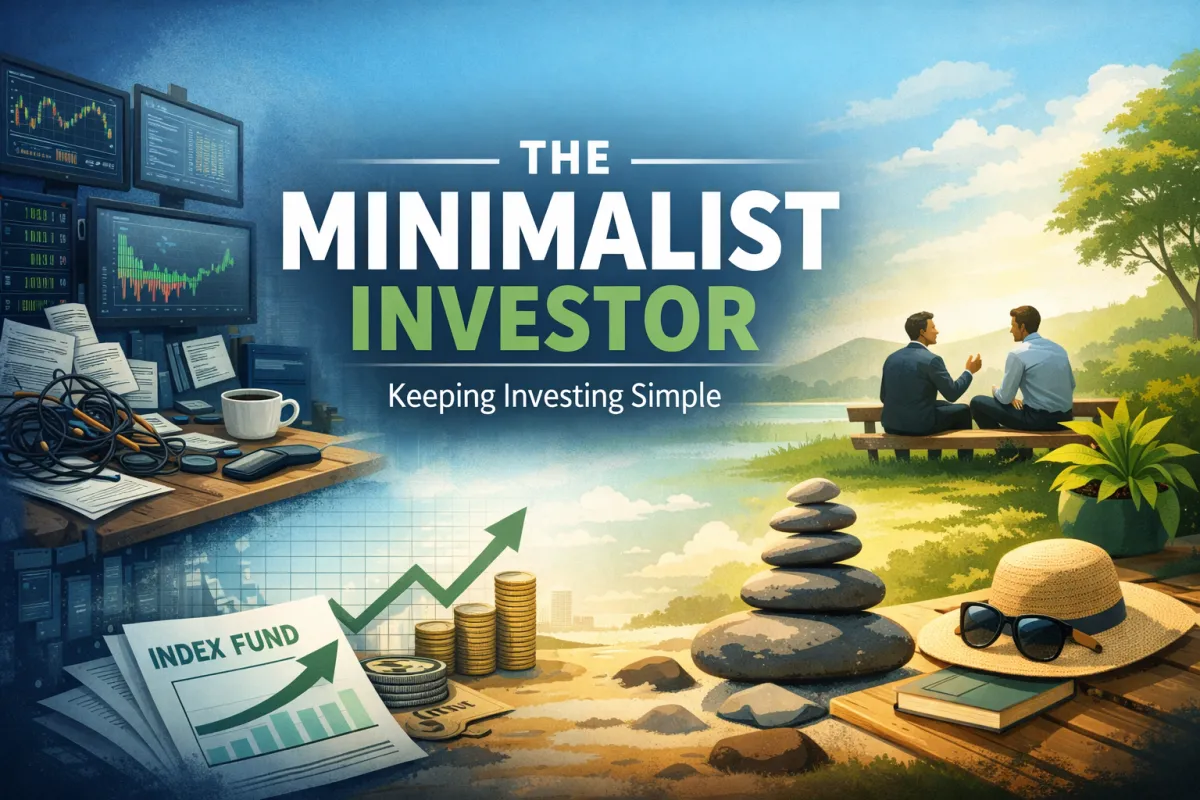
The Minimalist Investor: Why Simplicity Wins in the Long Run
Investing today feels more complicated than ever.
There are more strategies, more products, more data, more commentary, and more pressure to “do something.” You can factor tilt, rotate sectors, trade volatility, optimize tax loss harvesting, and build complex alternatives portfolios. You can chase private credit, hedge with options, or try to outmaneuver the next macro shift.
But here is the uncomfortable truth. Most of this complexity is unnecessary.
In fact, for most investors, complexity is not just unnecessary. It is harmful.
The highest probability path to long-term investment success is remarkably simple. Low-cost index funds, broadly diversified, held over time, with minimal interference. The real challenge is not intellectual. It is emotional.
And that is where most investors fail.
Investing Has Already Been “Solved”
If you zoom out and look at decades of research, the conclusion is surprisingly consistent. Markets are hard to beat.
Active managers, even professionals with teams, data, and resources, rarely outperform over long periods. Only a small percentage consistently beat their benchmarks. Studies show that roughly 4% of U.S. active funds outperform over 20 years.
This is not a coincidence. It is structural.
Markets are competitive. Prices incorporate information quickly. The biggest drivers of long-term returns often come from a small number of standout companies. These winners are extremely difficult to identify in advance. Missing just a handful of them can dramatically reduce returns, which is one reason concentrated or active approaches struggle to keep up over time.
Passive investing solves for this.
Owning the market through low-cost index funds means you automatically capture those winners.
No forecasting required. No trading skill required. No constant decision-making required.
Just participation.
Low-cost index funds provide diversification, tax efficiency, and market-level returns with minimal friction.
So if investing is largely solved, why do investors still struggle?
The Real Problem: Human Behavior
The biggest risk to your portfolio is not the market.
It is you.
Investors do not typically fail because they chose the wrong asset class. They fail because they interrupt the process. They chase performance, panic during downturns, or overreact to headlines.
The irony is that the more engaged an investor becomes, the more likely they are to underperform.
Why?
Because markets do not reward activity. They reward discipline.
Research consistently shows that behavioral mistakes such as buying high, selling low, and attempting to time the market can cost investors significant returns over time. This is where simplicity becomes powerful. A minimalist strategy reduces decision points, which reduces the opportunity for mistakes.
And mistakes compound.
Complexity Feels Productive, But It Usually Isn’t
There is a psychological trap embedded in investing. Complexity feels like progress.
If you are analyzing, trading, adjusting, and optimizing, it feels like you are improving outcomes. It feels like work. It feels like control.
But most of that activity is noise.
Adding complexity rarely improves expected returns. More often, it increases costs, taxes, and the likelihood of poor timing decisions.
Even sophisticated strategies that aim to outperform, such as factor tilts, tactical allocation, or thematic investing, introduce tracking error. Tracking error creates discomfort. Discomfort leads to bad decisions.
In other words, complexity does not just add risk. It amplifies behavioral risk.
Minimalism removes friction. It creates clarity. It reduces the number of decisions you have to get right.
In investing, fewer decisions is often a competitive advantage.
The Hidden Cost of Chasing “More”
Many investors believe that with enough effort, they can push returns higher, for example from 11% to 15%.
This framing is misleading.
Consistently outperforming the market is extraordinarily difficult, even for professionals. The pursuit of higher returns often leads to worse outcomes, not better ones.
In trying to optimize returns, investors often:
Trade too frequently
Increase costs and taxes
Take on unintended risks
Abandon strategies at the wrong time
The result is not 15%. It is often less than the market return they could have achieved by doing less.
More importantly, even if you could improve your returns slightly, the question is whether it is worth your time.
For most people, the answer is no.
Your Time Is Better Spent Elsewhere
This is one of the most overlooked ideas in investing.
Your portfolio is not your highest return on time activity.
Your career, your business, and your skills are far more powerful drivers of wealth. Improving your income by 10 to 20 percent will almost always have a greater impact on your financial future than trying to squeeze out incremental returns from your portfolio.
Yet many investors do the opposite. They spend hours optimizing their investments while neglecting the areas that actually move the needle.
This is backwards.
A minimalist investor recognizes that investing should be efficient, not consuming. The goal is not to maximize engagement. It is to maximize outcomes with minimal effort.
Your portfolio should support your life, not dominate it.
The Case for Delegation
This is where financial advisors can play a critical role.
Not because they pick better stocks, but because they help investors stay disciplined.
Research from Vanguard’s Advisor’s Alpha framework suggests that working with an advisor can add roughly 3% in net annual value. This comes largely from behavioral coaching, tax efficiency, and disciplined rebalancing rather than market timing or security selection.
That is a meaningful number.
More importantly, advisors help solve the real problem, which is behavior.
They provide:
Structure during volatile markets
Accountability to a long-term plan
Protection against emotional decision-making
Time savings and reduced cognitive load
Some research also suggests that investors working with advisors accumulate more wealth over time and are more likely to achieve their financial goals.
This is not about outsourcing intelligence. It is about outsourcing discipline.
For many investors, that is worth far more than any marginal improvement in portfolio construction.
Simplicity Is Not Laziness. It Is Strategy
Minimalism in investing is often misunderstood.
It is not about doing nothing. It is about doing only what matters.
A well-constructed, low-cost portfolio aligned with your goals and risk tolerance is not simplistic. It is optimized. The decision to avoid unnecessary complexity is intentional.
In many ways, simplicity is harder than complexity.
It requires:
Patience when others are chasing trends
Discipline during market volatility
Confidence in a long-term plan
The humility to accept market returns
This approach is grounded in evidence.
Passive investing works not because it is exciting, but because it removes the variables that lead to underperformance.
The Emotional Tradeoff
There is one honest downside to minimalist investing.
It is boring.
There are no big calls. No dramatic wins. No stories to tell at dinner parties.
You will not feel like you are beating the system.
That is exactly why it works.
The excitement that investors seek, the urge to act, to optimize, to outsmart, is often the very thing that destroys returns.
Minimalist investing replaces excitement with consistency. It trades short-term engagement for long-term outcomes.
That may feel unsatisfying in the moment, but it is incredibly powerful over time.
The Compounding Advantage of Doing Less
The most important force in investing is compounding.
Compounding requires time.
Every unnecessary trade, every emotional decision, and every deviation from the plan interrupts that process.
Minimalism protects compounding.
It allows returns to build uninterrupted. It reduces friction. It keeps investors aligned with the strategy long enough for it to work.
Over decades, that difference becomes enormous.
A Simple Framework for Minimalist Investing
For most investors, a minimalist approach can be summarized in a few key principles:
Use low-cost index funds
Capture market returns efficiently without trying to outguess themDiversify broadly
Own global equities and high-quality fixed income aligned with your risk toleranceMinimize costs and taxes
Keep expense ratios low and avoid unnecessary tradingStay disciplined
Maintain your allocation through market cyclesReduce decision-making
Limit the number of changes and adjustments you makeConsider delegation
If managing behavior is a challenge, work with an advisor
That is it.
No complexity required.
The Bottom Line
Investing does not need to be complicated to be effective.
In fact, the opposite is usually true.
Low-cost index funds have already solved the core investment problem. The real challenge is not finding a better strategy. It is sticking with a good one.
The more you try to optimize, the more likely you are to interfere with your own success.
Minimalist investors understand this. They focus on what matters, ignore what does not, and allow compounding to do the heavy lifting.
Most importantly, they recognize that investing is not the main event.
It is a tool.
A means to an end.
A way to support a life that is richer, more fulfilling, and more aligned with what truly matters.
The goal is not to become a better trader.
It is to become a better allocator of your time, your energy, and your attention.
Because in the end, the best investment you can make is not just in your portfolio.
It is in your life.
