The Great Bifurcation: Why the Market Is Both Terrifying and Thrilling
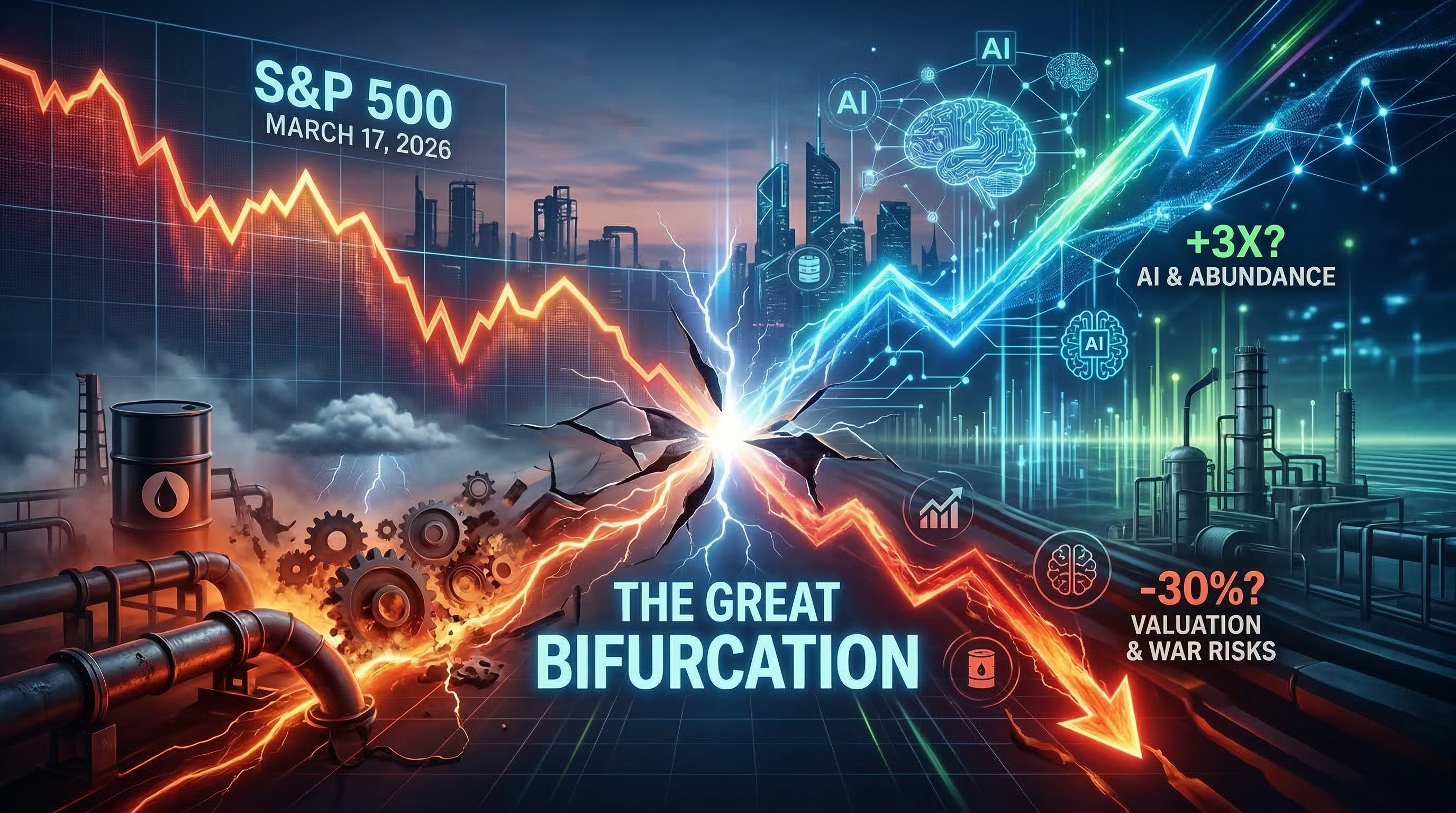
This market is simultaneously priced for perfection and braced for impact. As of March 17, 2026, the S&P 500 sits in a strange limbo: it could drop 30% tomorrow and still be "expensive" by historical standards, yet it could more than double by 2035 if the massive AI investments currently underway bear fruit.
This is the Great Bifurcation. On one side, a hot war in the Middle East, record-high valuations, and crazy data center spending. On the other, a productivity revolution that could rewrite the rules of the global economy.
War But Not a Flight To Safety
Between February 27 and March 16, we witnessed a violent shift in the macro environment. The transmission mechanism is clear but different than recent wars. This this war we have: war disrupts oil. Higher oil fuels inflation. Inflation spikes yields. Higher yields drag down stocks.
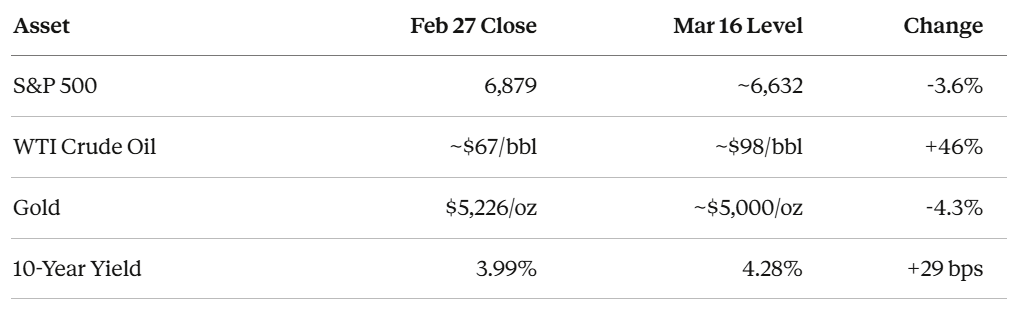
A mortgage banker I know commented to me that he was surprised at this and had expected the safety trade to bring down rates. That's not what has happened. Brent crude has crossed $100 for the first time in years. The Fed is now unlikely to cut near-term with Core PCE at 3.1% and rising and yet labor markets shed 92,000 jobs in February and are weakening. The near-term path is treacherous.
Valuation: The Math of the Bear Case
Michael Burry had a piece out recently that he moved out from his paywall to make it accessible to all. In it he argued that market valuations have simply been stretched too far. The Shiller CAPE ratio stands at 38.3, placing us in the 98th percentile of all historical readings - a level only surpassed during the peak of the Dot-com bubble.
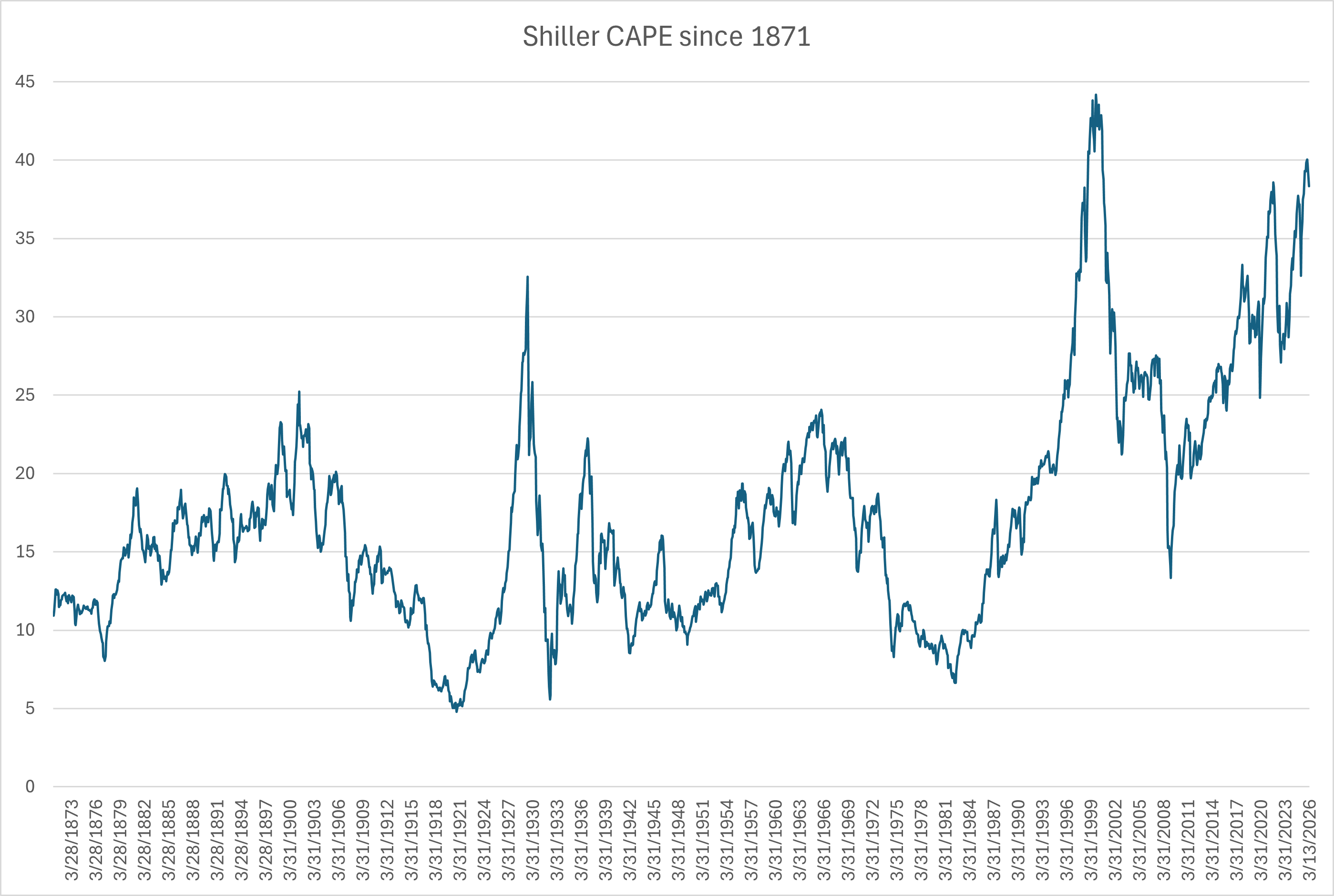
The Math of Disillusionment. To understand the risk, look at what happens if we simply return to the "new normal" average since 1990: a CAPE of 27.2. A reversion to that mean alone implies a 29% drop in the S&P 500, assuming earnings stay flat. Revert to the long-run historical mean of 17.3, and the market would need to fall by over 50%. As markets tend to overshoot, you could look to the even further drop back to 2009 levels - which would require a 2/3rds drop in the S&P 500.
John Hussman's MarketCap/GVA metric suggests that even without a crash, starting from these prices locks investors into a "1% Decade" where nominal returns will lose to 3% inflation. The bear case, in short: we have pulled a decade of future returns into the present, leaving an empty tank for the years ahead.
The Berkshire Signal. Warren Buffett retired on January 1, 2026, leaving Greg Abel with $382 billion in cash. After selling stocks for 12 straight quarters, Buffett effectively stated his thesis: the "Risk-Free Rate" of T-bills at 4%+ is far superior to the "Risk-Heavy" returns of stocks at a 38 CAPE.
The $700 Billion AI Gamble: Risky, But Points to the Bull Case
The valuation bears have math on their side. And further they point to the crazy buildout of the AI data center infrastructure. The "Big Five" hyperscalers are projected to spend up to $700 billion on capex in 2026 alone. And for what? OpenAI and Anthropic, the two leading AI model builders, had revenue of no more than $20B in 2025. Even in their wildly optimistic projections, revenue will not exceed $100B in 2026 and could well be much less.
This points to the risk that commentators such as Howard Marks and Michael Burry are pointing to - this may be a waste of capital far worse than the dot-com boom. It is risky, and if it doesn't pay off, the Mag 7 could easily lose half their value and drag the market into a deep bear.
However, what if these crazy investments pay off? What if you get $500B in AI model sales in 2028 and $1.5 trillion in 2029? What if you can truly replace large swaths of the 700 million people and $40 trillion developed world human labor market with AI?
The Math of Abundance. The bull case is about creating new digital workers and using digital workers as labor replacement. We can get to these numbers by replacing ~1% of labor in 2028, going to 3% in 2029.
If AI drives productivity growth from the current 2.2% trend to a 5-6% level, nominal GDP growth could surge to 8% or higher. Corporate margins wouldn't just stay high - they'd expand from 13.9% toward 20% as the cost of cognitive labor collapses.
If S&P 500 earnings grow at a 12.5% CAGR (consistent with a productivity revolution), EPS would reach $900 by 2035. Even if the market's P/E multiple compresses from 22x down to 18x, the index would still hit 16,200. That's a 10% stock market CAGR driven by fundamental earnings growth, not speculative fever.
The ArcVest Playbook: How to Invest Today
The market in 2026 is both dangerously expensive and potentially the launchpad for the greatest economic expansion in a generation. Our rules for navigating this Bifurcation:
Don't Be All-Out. The productivity revolution is too real to ignore. Sitting entirely in cash means missing the potential for S&P 16,000.
Don't Chase Price. Buying at the 98th percentile of valuation is a recipe for a 10-year wait to break even if the AI miracle is delayed.
Diversify Beyond U.S. Large Cap International Developed (e.g. SPDW) and Emerging Markets (e.g. VWO) trade at deep discounts to the S&P. Gold remains a useful hedge.
Hold Dry Powder. Follow the Buffett/Abel playbook. Cash is the only asset that lets you buy aggressively when a reset arrives.
