Global Margin Call
The war in Iran is starting to metastasize into something potentially much worse: a fracturing of the current world order.
We aren't there yet, and surely we can find a way back from the brink. However, we are starting to risk American financial prosperity and security much more than I believe the administration intended to.
Three weeks ago, the United States looked terrifying on the global stage. We took out Maduro in Venezuela. We took out the Ayatollah in Iran with absolute precision. We projected unquestioned, lethal competence.
Today, only three weeks later, we are starting to look bumbling. We have no clear way to secure the Strait of Hormuz, and we are standing by while major assets of our allies - most damagingly Qatar’s massive Ras Laffan LNG hub - get destroyed.
As Ray Dalio recently pointed out, if America cannot secure the Strait of Hormuz, we have lost global credibility in a massive, structural way. Let’s look at the dominoes that are starting to fall, and see where they lead if this war drags on or gets worse.
Domino 1: The Geopolitical Pivot to China Security is the bedrock of the global economy. For decades, the Gulf states relied on the U.S. security umbrella. Recently, they aggressively courted the Trump administration to solidify that bond.
But as their infrastructure burns and the Strait remains impassable, they are realizing their efforts with Trump have come to naught. If the U.S. cannot or will not protect them, they will be furious - and they may look to China to secure their interests.
This creates an unwanted contagion in the Pacific. If Japan, South Korea, and Taiwan see that the United States cannot protect the most critical energy chokepoint on earth, they will realize the U.S. security umbrella is leaking. Out of sheer survival, they will have to start looking toward Beijing and cutting their own deals.
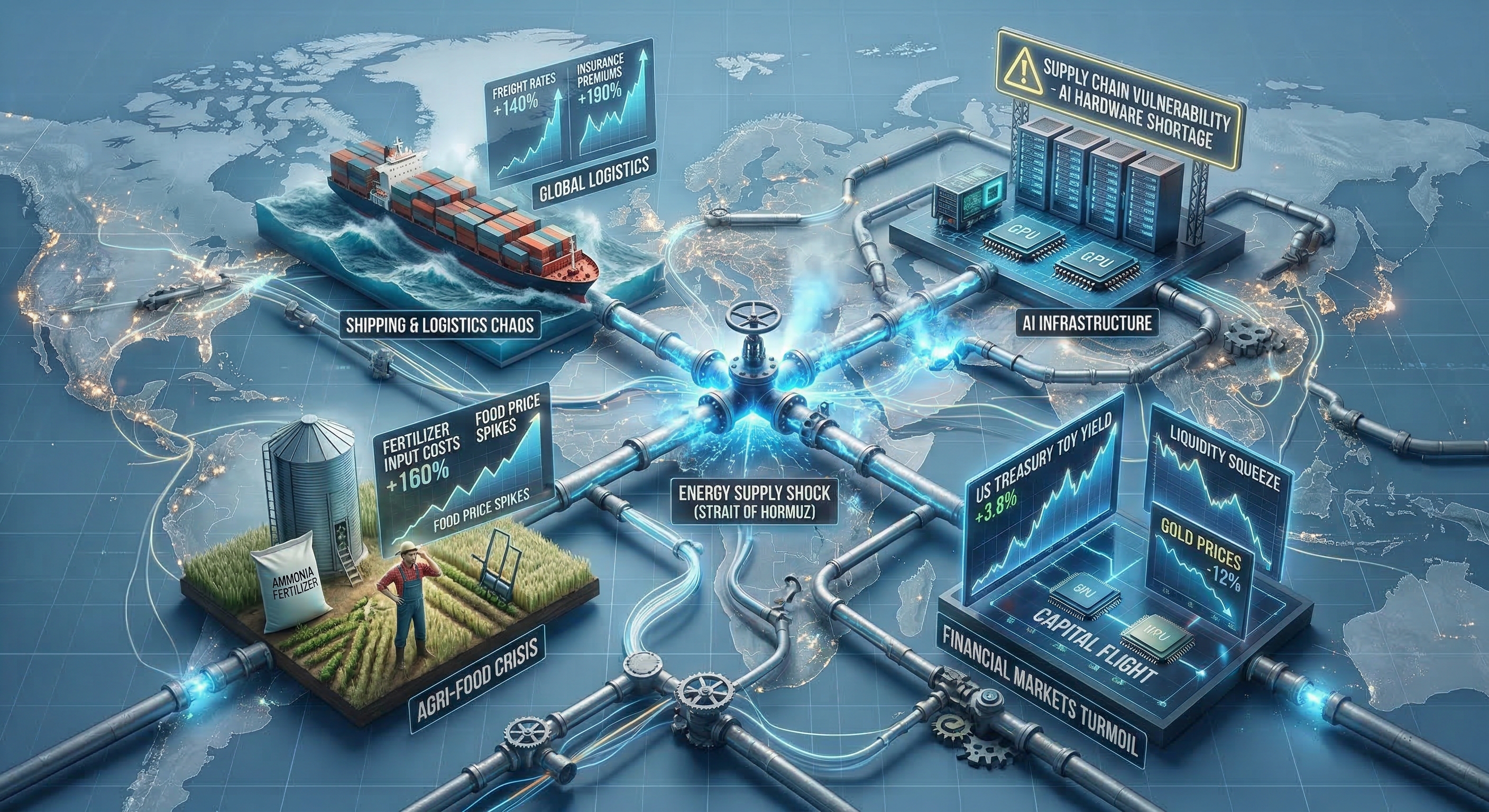
Domino 2: The Capital Flight This geopolitical shift has immediate, brutal consequences for U.S. asset prices. Gulf Sovereign Wealth Funds manage roughly $6 trillion. In recent years, they have poured hundreds of billions into U.S. markets. They are anchor investors for massive private equity funds (Blackstone, KKR, Apollo) and primary co-financiers of our the massive multi-trillion dollar AI infrastructure buildout.
If the Gulf pivots to China for security, their capital goes with them. Private equity fundraising will hit a wall. The AI frontier labs and hyperscalers will lose patient capital, forcing a sizeable reduction in AI capex. That instantly reprices OpenAI and Anthropic and by extension Nvidia, the Mag 7, and the broader U.S. equity market.
Domino 3: Japan’s Double Bind and the Treasury Sell-off Japan is heavily reliant on imported oil and LNG. With the Gulf disrupted and Ras Laffan damaged, Japan is facing severe energy shortages and massive price spikes of its own.
Simultaneously, Japan holds over $1.2 trillion in U.S. Treasuries. With their own security environment degrading, domestic inflation rising from energy shocks, and US Treasuries now producing no net financial benefit after hedging costs, Japanese institutions are being forced to act. They are repatriating capital to fund their own historic $275 billion defense buildup and shore up their domestic economy.
When the largest foreign holder of U.S. debt starts selling, U.S. interest rates spike.
Domino 4: The Liquidity Squeeze (Why Gold Drops) If you want proof that the system is stressing, look at gold. Gold is often a safe haven during war, and it should do very well in an inflationary world. But recently, gold prices have fallen. Why? Because we are entering a liquidity squeeze and margin call.
When energy costs spike, inflation rises, and bond yields shoot up, investors get squeezed for cash. In a true liquidity crunch, investors do not sell what they want to sell - they sell what they can sell. Gold is highly liquid, and it has had a historic recent run. It is being sold to cover margin calls and raise cash. When you see gold dropping during a geopolitical crisis, it means the plumbing of the financial system is starting to choke.
Domino 5: The Broad Inflation Shock Finally, the physical plumbing of the economy is breaking. With the Strait effectively closed, insurance and freight costs are rising rapidly. That means everything that travels by sea - chemicals, plastics, machinery - costs more.
Further, modern farming requires nitrogen fertilizer, which requires natural gas as an input and an energy source. As gas supplies tighten, fertilizer prices jump. This alters global crop planting, substituting more soy for corn, thus raising cattle prices, and generally pushing food prices higher across the board.
Gasoline prices are already rising at the pump; transportation, chemicals, and plastics will rise with oil; food prices will rise on a lag; mortgage rates have already risen 25 bps; and with inflation coming the Fed will be hard pressed to lower rates. A new inflation impetus has been added to the economy, and it is only going to get worse from here.
The Bottom Line We have created a storm of seemingly unintended consequences. If we do not find a way to stabilize this quickly, the math is grim and unavoidable:
Gas prices will go up.
Broad inflation will go up.
Interest rates will go up.
Systemic liquidity will go down.
Stock prices will go down.
Most importantly, our overall national security and global hegemony will be permanently degraded. We are risking the geopolitical subsidy that has funded American prosperity for nearly a century. Let's hope the administration can find a way to bring this war to a quick and successful conclusion, but at this moment, the odds don't look good.
