There Is No Perfect Portfolio
If you spend enough time in the world of investing, you will inevitably run into someone who claims to have found the “perfect” portfolio. Maybe it is a three-fund portfolio. Maybe it is a complex mix of eight or ten funds. Maybe it is a carefully curated list of individual stocks and bonds. The promise is always the same: better returns, lower risk, smarter construction.
The truth is much simpler and far more important.
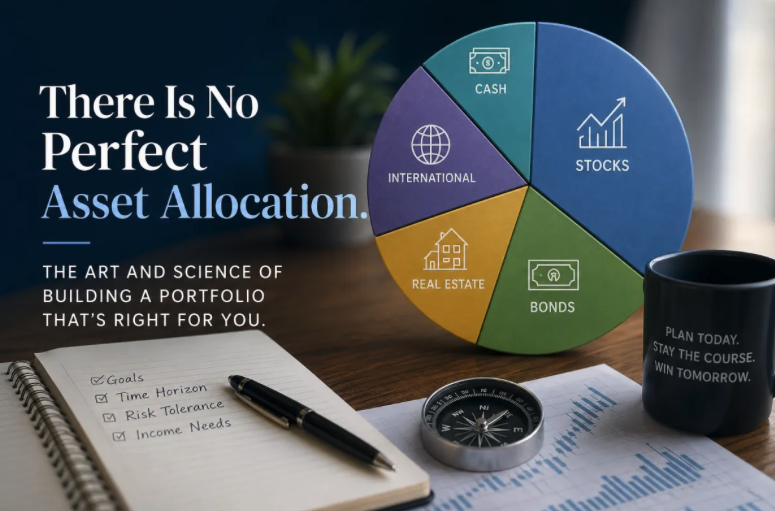
There is no perfect asset allocation.
What exists instead is an asset allocation that is appropriate for you. And that distinction is everything.
The Art and Science of Asset Allocation
Asset allocation sits at the intersection of science and human behavior.
The science side is well documented. Decades of research show that how you divide your money across major asset classes—stocks, bonds, real estate, cash—drives the majority of your long-term investment outcomes. Not market timing. Not stock picking. Not chasing the latest trend.
It is the mix.
But the art side is where most investors struggle. Because the “right” mix is not determined by spreadsheets alone. It is shaped by your life. Your goals. Your tolerance for risk. Your ability to stay disciplined when markets get uncomfortable.
Two investors can look at the same data and arrive at very different, yet equally valid, portfolios.
That is not a flaw in the system. That is the system working as intended.
Why Your Allocation Is Not My Allocation
A 30-year-old building wealth for retirement has a completely different investment reality than a 65-year-old preparing to draw income from their portfolio.
The younger investor has time on their side. They can withstand volatility. They can lean heavily into equities, knowing that short-term downturns are part of the journey.
The retiree, on the other hand, faces sequence-of-returns risk. A market downturn early in retirement can have an outsized impact. Stability, income, and downside protection matter more.
Even within similar age groups, differences emerge.
- One investor may have a high tolerance for risk because they have stable income and a long runway.
- Another may prefer a more conservative approach because market swings cause stress and lead to poor decisions.
- One may have concentrated stock exposure through their job.
- Another may have significant real estate holdings outside their portfolio.
These differences are not minor. They are foundational.
So when someone says, “This is the best portfolio,” the immediate response should be, “For whom?”
The Three-Fund Portfolio: Elegant Simplicity
The three-fund portfolio has become something of a gold standard for simplicity.
At its core, it typically includes:
- A total U.S. stock market fund
- An international stock market fund
- A total bond market fund
That is it.
Three funds. Broad diversification. Low cost. Easy to manage.
The appeal is obvious. It removes complexity. It reduces the temptation to tinker. It keeps investors focused on what actually matters: staying invested and maintaining discipline.
For many investors, this approach is more than sufficient. It captures the majority of global market returns. It is tax-efficient. It is easy to rebalance. And perhaps most importantly, it is understandable.
Simplicity is not a weakness in investing. In many cases, it is a competitive advantage.
The Eight-Fund Portfolio: Precision and Customization
On the other end of the spectrum, some investors prefer a more granular approach.
An eight-fund portfolio might break the market into smaller pieces:
- U.S. large-cap stocks
- U.S. small-cap stocks
- International developed markets
- Emerging markets
- Real estate
- U.S. bonds
- International bonds
- Inflation-protected securities
This approach allows for more precise control over exposures. You can tilt toward small caps. You can overweight emerging markets. You can adjust fixed income based on interest rate views or inflation expectations.
For investors who understand what they are doing—and who have the discipline to stick with it—this can be a powerful framework.
But there is a tradeoff.
More complexity creates more opportunities for second-guessing. More levers to pull. More chances to get it wrong.
An eight-fund portfolio is not inherently better than a three-fund portfolio. It is simply more customizable. And customization only adds value if it is executed thoughtfully and consistently.
Individual Securities: Control with Consequences
Then there is the path of individual stock and bond selection.
On the surface, it is appealing. You can handpick companies you believe in. You can avoid areas you distrust. You can build a portfolio that feels uniquely yours.
But this approach introduces significant challenges.
First, diversification becomes harder to achieve. A portfolio of 10 or 20 stocks is not the same as owning thousands of companies across global markets.
Second, the burden of decision-making increases dramatically. You are now responsible for analyzing businesses, monitoring earnings, evaluating valuations, and determining when to buy or sell.
Third, the evidence is clear that most investors struggle to outperform broad market indexes over time, especially after costs and taxes.
This is why index funds have become such a powerful tool.
They allow investors to own entire markets at low cost. They remove the need to pick winners. They provide instant diversification. And they make it easier to focus on the bigger picture rather than individual outcomes.
That does not mean individual securities are always wrong. But for most investors, most of the time, index funds provide a more reliable and efficient path.
Diversification Means Always Being Uncomfortable Somewhere
One of the hardest truths in investing is this:
A well-diversified portfolio is designed to disappoint you.
At any given time, something in your portfolio will be underperforming.
- When U.S. stocks are leading, international stocks may lag.
- When growth stocks are surging, value stocks may struggle.
- When equities are strong, bonds may feel like a drag.
- When inflation spikes, traditional fixed income may disappoint.
This is not a flaw. This is diversification working.
If every part of your portfolio is performing well at the same time, you are likely not diversified. You are concentrated in whatever is currently winning.
Diversification spreads your bets. It reduces the risk of catastrophic outcomes. It smooths the ride over time.
But the cost of that protection is that you will never have all your assets firing on all cylinders at once.
That can feel frustrating in the short term. It can even feel like a mistake.
But over decades, it is one of the most powerful tools investors have.
The Real Goal: A Portfolio You Can Stick With
The best asset allocation is not the one that looks perfect on paper.
It is the one you can stick with when markets get difficult.
Because markets will get difficult.
There will be periods of sharp declines. There will be long stretches of underperformance. There will be headlines that make you question everything.
If your portfolio is too aggressive, you may panic and sell at the worst possible time.
If it is too conservative, you may lose patience and take on risk at exactly the wrong moment.
Either way, the problem is not the market. It is the mismatch between your portfolio and your behavior.
This is why personalization matters so much.
Your asset allocation should reflect:
- Your time horizon
- Your income needs
- Your risk tolerance
- Your financial goals
- Your ability to stay disciplined
Not someone else’s.
Winning Over Decades, Not Days
Investing is not about winning every year.
It is about winning over decades.
That requires a shift in mindset.
Instead of asking, “What is the best-performing asset class right now?” the better question is, “What allocation gives me the highest probability of achieving my long-term goals?”
Instead of chasing what is working, the focus should be on building something durable.
Something that can withstand different market environments.
Something that does not require constant adjustment.
Something that allows you to stay invested.
Because the biggest risk to long-term success is not picking the wrong fund.
It is abandoning a good strategy at the wrong time.
Bringing It All Together
There is no perfect asset allocation because there is no perfect investor.
There are only individuals with different goals, different constraints, and different behaviors.
A three-fund portfolio can be the right answer.
An eight-fund portfolio can be the right answer.
Even a more customized approach can be the right answer.
What matters is not the number of funds or the level of complexity.
What matters is alignment.
Alignment between your portfolio and your life.
Alignment between your risk and your comfort level.
Alignment between your strategy and your ability to stay the course.
The art and science of asset allocation is not about finding perfection.
It is about finding fit.
And once you find an allocation that fits, the most important thing you can do is stick with it.
Because in investing, consistency often matters more than brilliance.
And over time, that consistency is what turns a good plan into great results.