The Quiet Power of Compounding: Why Starting Early Beats Starting Big
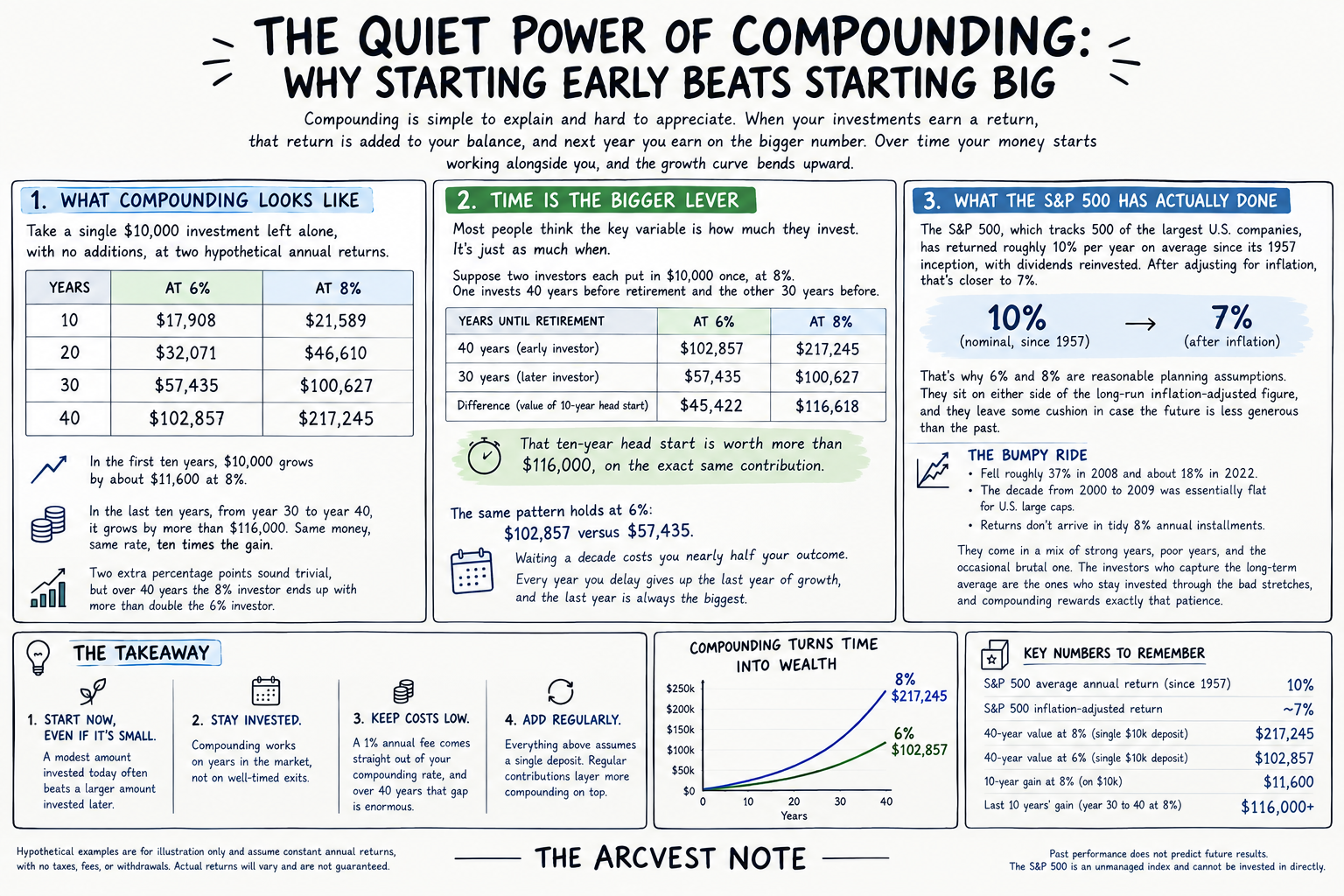
Compounding is simple to explain and hard to appreciate. When your investments earn a return, that return is added to your balance, and next year you earn on the bigger number. Over time your money starts working alongside you, and the growth curve bends upward.
What Compounding Looks Like
Take a single $10,000 investment left alone, with no additions, at two hypothetical annual returns:
| Years | At 6% | At 8% |
|---|---|---|
| 10 | $17,908 | $21,589 |
| 20 | $32,071 | $46,610 |
| 30 | $57,435 | $100,627 |
| 40 | $102,857 | $217,245 |
Look at the 8% column. In the first ten years, $10,000 grows by about $11,600. In the last ten years, from year 30 to year 40, it grows by more than $116,000. Same money, same rate, ten times the gain. Nothing about your behavior changed. The base was just larger.
The rate matters too. Two extra percentage points sound trivial, but over 40 years the 8% investor ends up with more than double the 6% investor.
Time Is the Bigger Lever
Most people think the key variable is how much they invest. It's just as much when.
Suppose two investors each put in $10,000 once, at 8%. One invests 40 years before retirement and the other 30 years before. The 40-year investor ends up with $217,245, the 30-year investor with $100,627. That ten-year head start is worth more than $116,000, on the exact same contribution.
The same pattern holds at 6%: $102,857 versus $57,435. Waiting a decade costs you nearly half your outcome. Every year you delay gives up the last year of growth, and the last year is always the biggest.
What the S&P 500 Has Actually Done
Hypotheticals are useful, but investors reasonably ask what the market has really delivered. The S&P 500, which tracks 500 of the largest U.S. companies, has returned roughly 10% per year on average since its 1957 inception, with dividends reinvested. After adjusting for inflation, that's closer to 7%.
That's why 6% and 8% are reasonable planning assumptions. They sit on either side of the long-run inflation-adjusted figure, and they leave some cushion in case the future is less generous than the past.
The 10% average also hides a bumpy ride. The index fell roughly 37% in 2008 and about 18% in 2022. The decade from 2000 to 2009 was essentially flat for U.S. large caps. Returns don't arrive in tidy 8% annual installments. They come in a mix of strong years, poor years, and the occasional brutal one. The investors who capture the long-term average are the ones who stay invested through the bad stretches, and compounding rewards exactly that patience.
The Takeaway
- Start now, even if it's small. A modest amount invested today often beats a larger amount invested later.
- Stay invested. Compounding works on years in the market, not on well-timed exits.
- Keep costs low. A 1% annual fee comes straight out of your compounding rate, and over 40 years that gap is enormous.
- Add regularly. Everything above assumes a single deposit. Regular contributions layer more compounding on top.
The best time to start was years ago. The second best time is this year.
Hypothetical examples are for illustration only and assume constant annual returns, with no taxes, fees, or withdrawals. Actual returns will vary and are not guaranteed. Past performance does not predict future results. The S&P 500 is an unmanaged index and cannot be invested in directly.