
Gold had its run in 2025. You saw the charts. You heard the stories at dinner parties. You felt the itch to buy right as the price peaked.
Now, the narrative machine has a new favorite toy: Oil.
Global production just hit a record high. The headlines are arriving on schedule. We are hearing about supply gluts, OPEC politics, and "super-cycles." The financial media is already asking the question that triggers the most dopamine in a speculator’s brain: “Is Oil in 2026 the new Gold of 2025?”
That question is designed to do one thing. It isn’t designed to inform you. It is designed to move you.
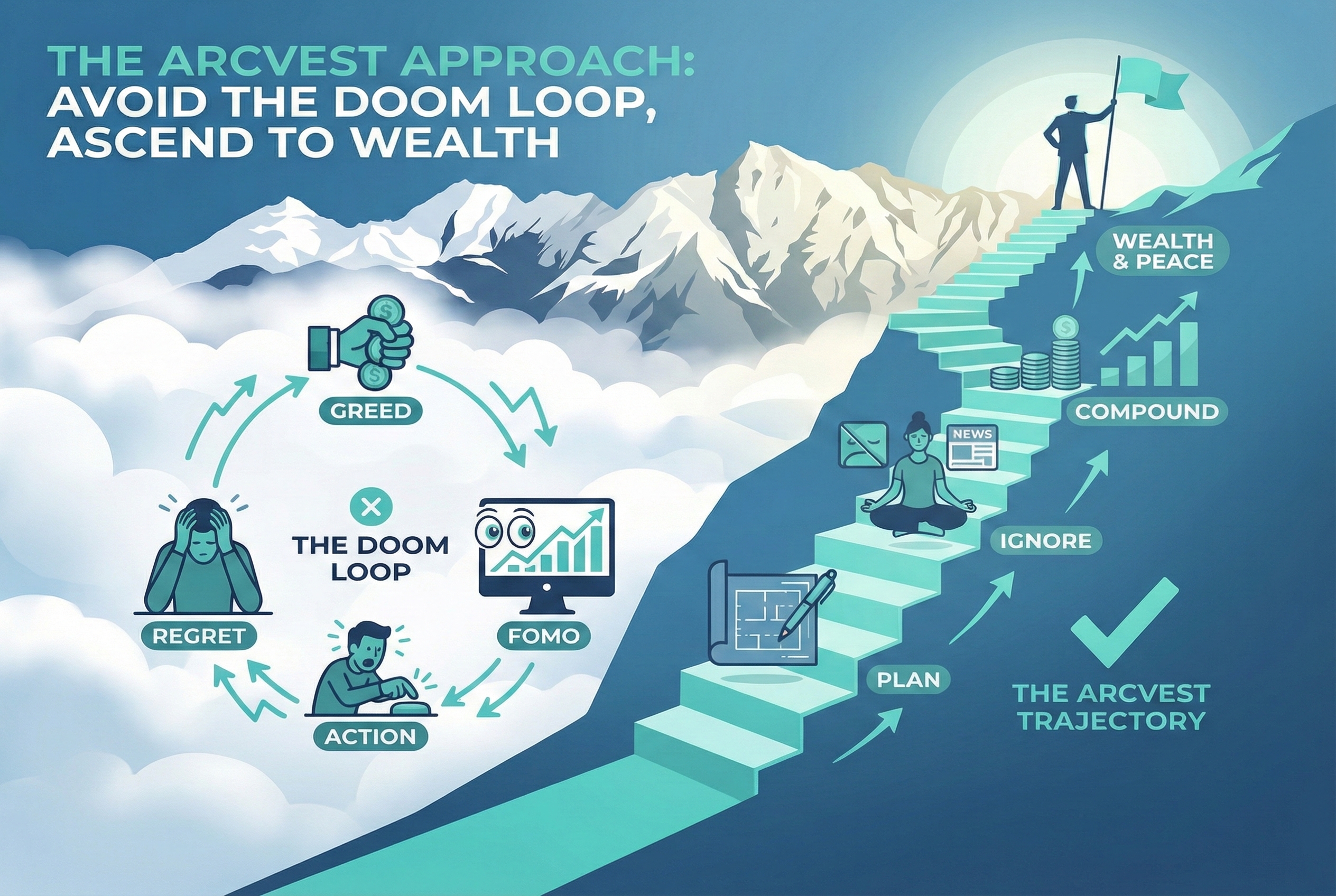
Wall Street runs on a very specific, profitable loop. Your job as an investor is to spot the loop and step out of it before it costs you money.
Phase 1: Headlines Create Emotion
The financial industry knows that "steady growth" is boring. Boring doesn’t sell ads, and it doesn’t sell products.
So, they take a data point—like record oil production—and wrap it in urgency. They turn a commodity into a character in a story.
- The Story: "Oil is volatile. The world is changing. You need to position yourself now."
- The Emotion: Greed (if you think it’s going up) or Fear (if you think the glut will crash the market).
Both emotions lead to the same destination: FOMO. The fear that you are standing still while the "smart money" is doing something clever.
Phase 2: Emotion Drives Motion
This is where the trap snaps shut.
Big macro news triggers a dangerous impulse in intelligent people: Act now, explain later.
You feel the need to "do something." Maybe you rotate out of tech and into energy. Maybe you buy a sector ETF. Maybe you call your advisor and ask if we are "exposed enough" to the energy sector.
Wall Street loves this. The industry loves motion.
- Motion creates commissions.
- Motion creates bid-ask spreads.
- Motion creates "tactical" funds with higher expense ratios.
- Motion justifies the existence of pundits.
Complexity is the industry’s favorite feature. It justifies the Fee Extraction Machine. If investing is simple, you don’t need them. If investing is a complex series of tactical rotations based on geopolitical oil forecasts, you need to pay them to guide you.
Phase 3: Motion Produces Costs (The Regret)
Here is the boring, profitable truth: Motion kills returns.
When you react to a headline, you are late. Public markets process widely known information almost instantly. By the time you read "Oil Production Hits Record," that fact is already priced in. You aren’t betting on the news; you are betting that you can interpret the news better than the collective wisdom of the entire market.
The data says you can’t.
- The Professionals Can’t Do It: Over the 20 years ending in 2023, more than 90% of U.S. large-cap active funds underperformed the S&P 500.¹ They have Bloomberg terminals and armies of analysts. They still lose.
- You Probably Can’t Do It: Researchers Barber and Odean analyzed thousands of household accounts. Their conclusion was blunt: "Trading Is Hazardous to Your Wealth." The households that traded the most earned the lowest returns.²
Every time you move your money in response to a headline, you incur a "friction tax." You pay taxes, fees, and the invisible cost of bad timing. This is the Regret phase of the loop.
The Art of Doing Nothing
The hardest thing to do in investing is to sit on your hands when the headlines are screaming.
If you own a broad, diversified index fund, you already own energy companies. You own them in exact proportion to their value in the market.
- If oil booms, your exposure grows automatically.
- If oil busts, your exposure shrinks automatically.
- You capture the return without predicting the future.
You don’t need to forecast OPEC. You don’t need to know if 2026 is the year of Oil.
The Bottom Line
The headlines want you to believe that successful investing looks like activity. It looks like reading charts, making calls, and "playing" the oil cycle.
Real successful investing looks like boredom.
It looks like building a plan that can survive a booming oil market and a crashing one. It looks like keeping your costs low and your taxes lower.
The loop is Greed $\to$ FOMO $\to$ Action $\to$ Regret.
The ArcVest model is Plan $\to$ Ignore $\to$ Compound $\to$ Wealth.
Oil production hit a record. Markets absorbed the news and moved on. You should too.
Sources
- S&P Dow Jones Indices, SPIVA U.S. Scorecard, Year-End 2023.
- Barber, Brad M., and Odean, Terrance, "Trading Is Hazardous to Your Wealth," Journal of Finance (2000).
- Berg, Florian; Koelbel, Julian F.; Rigobon, Roberto, "Aggregate Confusion: The Divergence of ESG Ratings," (2022).
Disclosures: ArcVest, LLC is a registered investment adviser. This article is for educational purposes only and does not constitute personalized investment advice. Investing involves risk, including the possible loss of principal. Consult a qualified advisor before making investment decisions.


