
Articles
There Is No Free Lunch in Income Investing
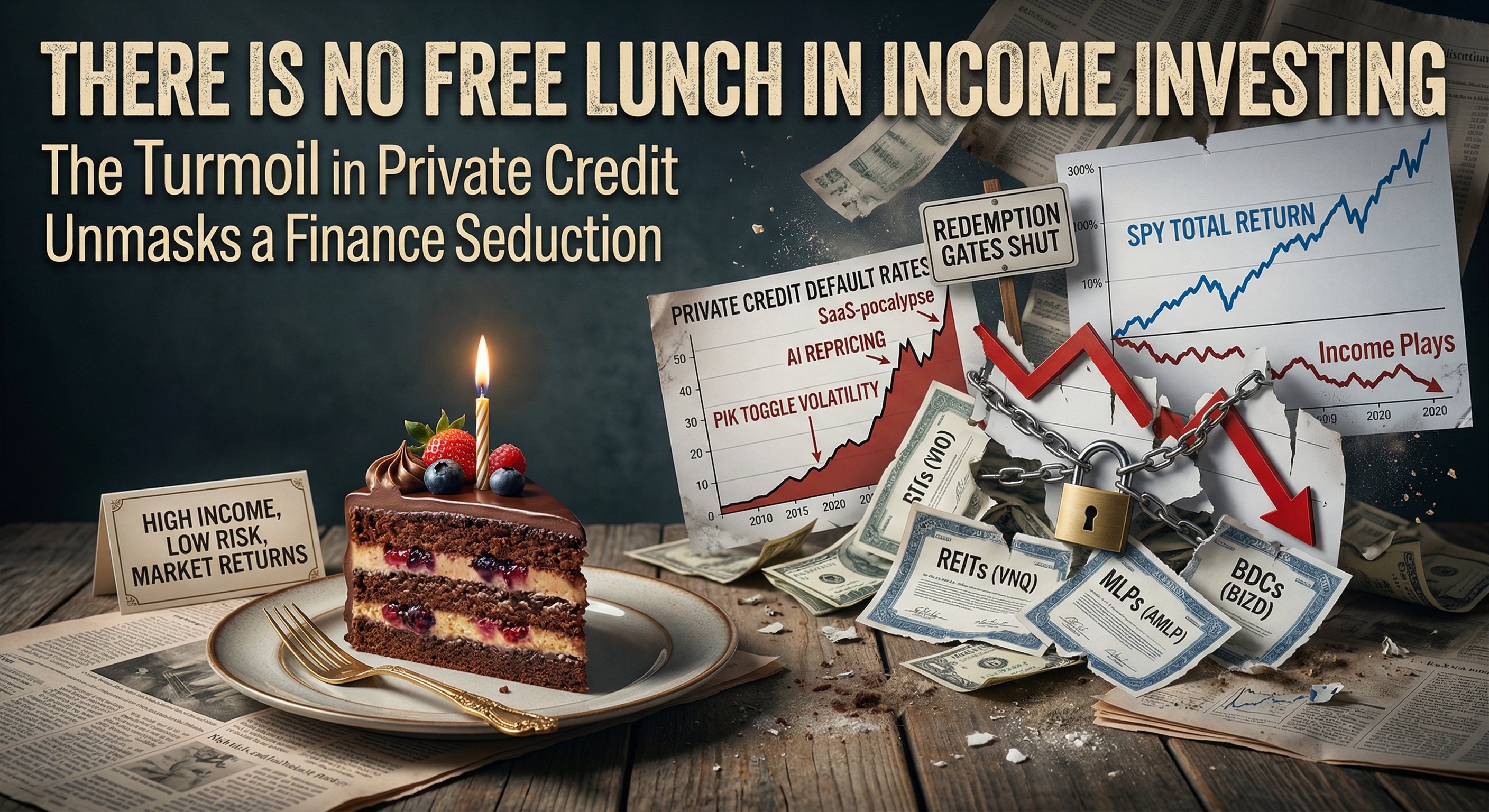
The recent turmoil in private credit is a timely unmasking of one of the most seductive stories in finance. It serves as a stark reminder of a hard truth: high income, low risk, and market-like returns do not exist in the same product. For the last decade, private credit was sold as the ultimate "have your cake and eat it too" solution. The pitch was simple: earn 8–9% annual income, capture a few points of equity upside, and enjoy "semi-liquid" access—all with lower volatility than the stock market. For years, that story seemed to hold up, largely because the checks kept arriving and the quarterly "marks" (valuations) were never challenged by reality.
Then came the pivot.
The Pivot: The "SaaS-pocalypse"
The illusion of stability began to fracture in early February 2026. As AI adoption accelerated, it began aggressively repricing legacy Software-as-a-Service (SaaS) companies. Since software borrowers represent roughly one-fifth of the private credit market, the "smooth" marks were suddenly under fire.
February 9: Default rate projections spiked toward 13% as analysts at UBS warned that AI was liquefying the "moats" of many private credit borrowers.
February 18: Blue Owl provided the first public signal of distress, announcing a sale $1.4 billion in assets to institutional buyers to shore up liquidity.
These funds had relied heavily on Payment-in-Kind (PIK) toggles - allowing struggling companies to pay interest with more debt instead of cash. While this looked fine on a spreadsheet, it was effectively "volatility laundering." It didn't remove the risk; it just delayed the recognition of it until the problem became too large to hide.
The Vicious Cycle: The Gates Shut
Once investors realized the underlying assets were being repriced, a spike in redemption requests turned into a stampede. This created a classic vicious cycle: limited liquidity led to "gates" being triggered, which only fueled more panic and more redemption requests.
By April, the "semi-liquid" promise was exposed as a polite fiction:
April 2: Blue Owl capped withdrawals after facing $5.4 billion in Q1 redemption requests. Its flagship fund (OCIC) saw investors try to pull 21.9% of the fund’s total shares.
April 6-9: The gates slammed shut across the industry. Barings and Ares hit their 5% limits, and Carlyle saw requests hit 15.7% - triple its allowable limit.
The unmasking is now complete. According to Bloomberg, over $4.6 billion in investor capital is currently "trapped" behind these gates. Even the Federal Reserve has reportedly begun asking major banks for data on their exposure to this sector.
Private credit was never a high-yield, low-risk miracle. It was always just illiquid debt with a better marketing department. As the tide goes out, we are seeing the reality: Income is not a free lunch; and high income is usually just risk with better branding.
The Income Illusion: Data Doesn't Lie
We fall for these products because our brains treat a dividend or coupon differently than a share sale. We mentally label one "income" and the other "principal," even though both are simply ways of converting portfolio value into cash.
Yield is not return. Over the last decade, every major "income play" has been smoked by a simple total-return approach using SPY (SPDR S&P 500 ETF Trust) as the benchmark.

1. The BDC Illusion (BIZD vs SPY)
The narrative of "steady checks" in Business Development Companies masks massive underperformance. The income failed to compensate for the fact that BDC prices get crushed in downturns and rarely recover with the same vigor as broader equities.
2. The REIT Trap (VNQ vs SPY)
Often sold as "real estate security," REITs are hyper-sensitive to interest rates. The 2022 drawdown was devastating, and they have struggled to find footing since.
3. Energy MLPs (AMLP vs SPY)
MLPs are even more volatile, with the catastrophic -32.19% drop in 2020 serving as a reminder that "infrastructure yield" is not a bond substitute.
The Scoreboard (Jan 1, 2016 – Dec 31, 2025)
Every single "income" play left massive money on the table versus just owning SPY.

The Aristocrat Myth
Even "safe" dividend strategies fail the test. In our study from January 2016 through December 2025, a boring 80/20 SPY/BIL portfolio (S&P 500 and T-Bills) returned 12.3% annualized. The Dividend Aristocrats (NOBL) returned only 10.1%.
A dividend is not a magic coupon; it is a rearrangement of wealth. When a company pays a dividend, that value leaves the company and enters your account. In a taxable account, you are often just accelerating a tax bill you didn't need to pay.
The Minimalist Solution
Investors chase yield because complexity feels sophisticated and "income" feels safer than "selling shares." But a 9% yield is a marketing hook; a total-return plan is a strategy.
The highest-probability path remains the most boring one:
Own a broadly diversified portfolio of low-cost, transparent public equities for growth.
Use high-quality bonds or Treasuries for stability and liquidity.
Sell what you need. Selling an appreciated asset isn't a failure - it's the most rational way to fund a lifestyle.
There is no secret product that manufactures extra return by slicing a portfolio into different buckets. There is just total return vs risk, coupled with cost and taxes. The private-credit redemption wave is stripping away the facade. When everyone wants out at once, the truth becomes obvious: the yield was never the whole picture.
Take your risk where markets are deep and liquid. Use bonds for stability. And remember: if the yield looks like a free lunch, you're the one paying for it.
Disclosure
ArcVest, LLC is a registered investment adviser. This article is for educational purposes only and does not constitute personalized investment, legal, or tax advice. All investing involves risk, including loss of principal. Past performance is not indicative of future results.

ArcVest
A fiduciary on your side.


Quick links
Support
Copyright 2026. ArcVest. All rights reserved.