
Articles
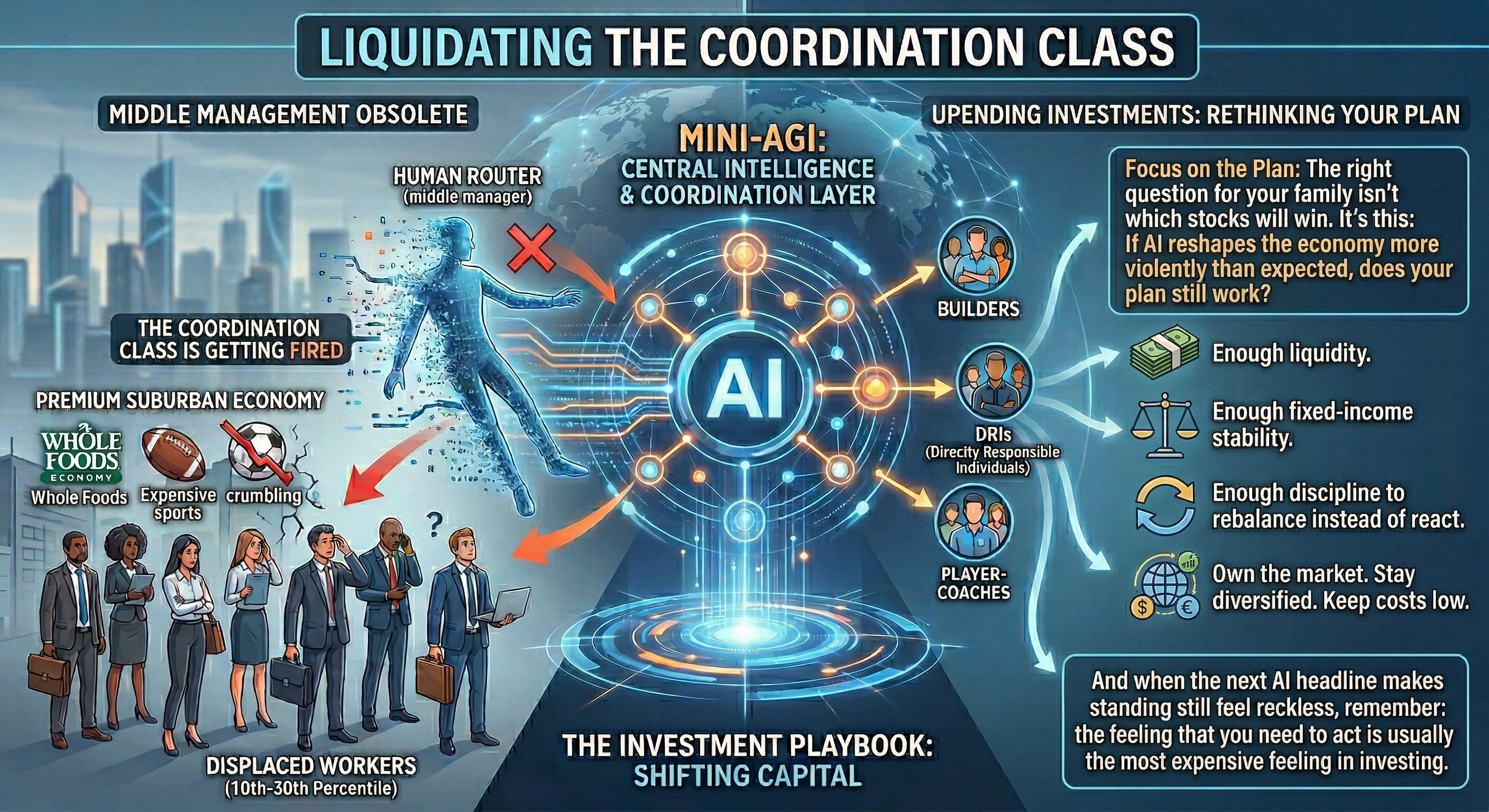
The Coordination Class Is Getting Fired
Jack Dorsey just published the playbook for eliminating middle management. Citrini Research modeled what happens when every CEO follows it.
Here is the reality: The "human router" is obsolete.
In February, Dorsey cut 4,000 people at Block. He didn't just trim the fat; he gutted the structure. Then he co-authored an essay with Sequoia’s Roelof Botha, "From Hierarchy to Intelligence," explaining why those roles are never coming back.
The argument is cold and mathematical: Corporate hierarchies exist to move information. When an organization gets too big for one person to oversee, they hire middle managers to route data.
Middle managers are human routers. AI is a better router. Dorsey is building a "mini-AGI" - a central intelligence layer that maintains a real-time model of the business and coordinates work. In this model, only three roles survive:
Builders: Individual contributors who create.
Directly Responsible Individuals (DRIs): Problem owners with a deadline.
Player-Coaches: People who build and develop talent simultaneously.
There is no room for the permanent middle management layer. Every CEO in the S&P 500 has read this or their board will be showing it to them shortly.
The 2028 Crisis: A Scenario in Motion
Just weeks before Dorsey’s manifesto, Citrini Research released "The 2028 Global Intelligence Crisis." It was a solid scenario analysis of what happens when the Dorsey playbook goes viral.
The feedback loop looks like this:
Companies cut white-collar headcount.
Margins expand. Earnings beat expectations. Stocks rally.
The savings are immediately plowed into more AI-driven efficiency.
The increase in AI efficiency further pushes headcount cuts.
The optimists - Frank Flight, Tyler Cowen, Morgan Stanley - argue that productivity shocks eventually create new jobs. They are right about the next decade but dead wrong about the next 24 months.
The 24-Month Death Zone
This displacement is very different than the past 20 years - it’s hitting the white-collar suburbs. We are talking about project managers, program directors, and senior analysts earning $150K–$300K.
This cohort is the engine of American consumer spending. They have:
$4,000/month mortgages.
Two luxury SUV leases.
Kids in $10k/year travel sports.
Lifestyles calibrated to a paycheck that is about to be compressed by an algorithm.
Amazon has already axed 14,000 corporate roles. Meta is running 50-to-1 employee-to-manager ratios. Shopify is flattening. This isn't just a future risk - it's happening right now.
The Three-Tier Economy
The economy is splitting into three distinct trajectories:
1. The 0.1% (The Owners)
When AI cuts labor costs by 30% while output holds steady, margins explode. The equity owners and founders capture the entire surplus. Their wealth is accelerating into "scarcity assets" - high-end real estate, collectibles, and vintage cars.
2. The 10th to 30th Percentile (The Displaced)
This is the Coordination Class. Their entire economic identity is built on sitting between executives and builders. As their income collapses, the ripple effects will gut the "premium" suburban economy - from Whole Foods to high-end batting practice.
3. The Bottom Two-Thirds (The Physicals)
Plumbers, electricians, and nurses are safer, but not unscathed. These jobs won't disappear, but as white-collar supply floods the market, pay for less-skilled physical labor will decline. Dollar General and Walmart win here as the former project manager trades down to drive Uber.
The Investment Playbook: Who Wins?
If you believe the Coordination Class is being liquidated, you can see who benefits:
Known Winners: As we have discussed before, some winners have been clear for the past two years - this trade is well known. These include:
AI-specific semiconductor manufacturing: Nvidia, TSMC, and Broadcom. Headcount savings are being converted directly into silicon.
Energy and Power: You cannot code a power plant. GE Vernova and Constellation Energy own the physical bottleneck. AI requires electricity, and the supply is finite
Scarcity Plays (The "Physical Wall"): We discussed these in our blog post last week
Positional Scarcity: High-end real estate in land-constrained markets (Aspen, Jackson Hole, Malibu) and blue-chip art.
Gold: The ultimate hedge against macro instability. When upper-middle-class defaults hit the mortgage market, you want an asset that doesn't have counterparty risk.
Permissioned Infrastructure: Energy pipelines, railways, etc. You can't disrupt a pipeline with an LLM. Their value is anchored in the legal impossibility of building a competitor.
Disruption Winners: The companies that can manage to thrive in this coming economic maelstrom
"Trade-Down" Giants: Costco, Walmart, McDonald's, and AutoZone. When a $200K household becomes a $90K household, spending moves downmarket.
Bloated "Turnarounds": Look for companies with massive SG&A (consulting, insurance, big bank back-offices) that the market has written off as "AI losers." If they cut their coordination layers by 40% while maintaining revenue, they aren't losers - they may become cash machines.
The Last Bastions: Defense and regulated industries (Lockheed, UnitedHealth, Palantir). The government will be the last hierarchy to flatten.
The Execution Gap
The hardest part of all this is mapping out these moves and placing your bets before the market can place theirs. Having a thesis about where the economy is going and having an investable edge are two different things. The history of investing punishes people who confuse the two.
Every idea above is a story about the future. Stories about the future have a problem: to beat a diversified portfolio, you have to be right about six things simultaneously:
Direction 2. Magnitude 3. Timing 4. Competition 5. Regulation 6. Valuation
A technology can transform the economy without producing a durable list of equity winners. Sometimes the benefit goes to infrastructure providers; sometimes competition passes the benefit to customers and compresses margins for everyone.
When innovation accelerates, forecasting gets harder. When analysis becomes cheaper and widely available, informational edges erode faster. When business models get repriced quickly, the line between "visionary growth company" and "temporary beneficiary" blurs.
The question for wealthy investors is whether any one fund manager can reliably map how the gains will distribute across public equities after competition, regulation, capital spending, and valuation are all taken into account.
We don't think so. We think the market, collectively, processes new information faster and more accurately than any single investor or advisor over long stretches of time.
So we own the market.
The Strategy: What We Actually Do
We have strong opinions about where this is going. We write about them because we think our clients should understand the forces reshaping their world. But we don’t confuse understanding the landscape with trading it.
We own the market.
Diversification as Defense: If AI creates massive winners, broad ownership gives you exposure. If it destroys existing business models, diversification limits the damage from the casualties.
Ignore the Impulse: "Do something about AI" is an expensive impulse. It usually means chasing recent winners, adding cost, and increasing concentration.
Focus on the Plan: The right question for your family isn't which stocks will win. It’s this: If AI reshapes the economy more violently than expected, does your plan still work? Enough liquidity. Enough fixed-income stability. Enough discipline to rebalance instead of react. Own the market. Stay diversified. Keep costs low. And when the next AI headline makes standing still feel reckless, remember: the feeling that you need to act is usually the most expensive feeling in investing.
ArcVest is a fee-only fiduciary registered investment adviser. This commentary is for informational purposes only and does not constitute investment advice or a recommendation to buy or sell any security. All investments involve risk, including loss of principal. Past performance does not guarantee future results.

ArcVest
A fiduciary on your side.


Quick links
Support
Copyright 2026. ArcVest. All rights reserved.