
Articles

When "Exclusive" Just Means "Stuck"
For the last two decades, Wall Street sold a specific brand of "sophistication": if you weren't in some exclusive private equity, private credit, or exotic alternatives, you weren't a "serious" investor. The pitch was always about "alpha" and "access."
The reality? You were often just buying illiquidity and paying a premium for the privilege of not seeing your marks move. In 2026, you are realizing the returns aren't better and you are just stuck in a bad set of funds.
The Liquidity Stress Test
We can see this most readily in private credit. The "semi-liquid" private credit market is currently facing its first real reckoning. In the first quarter of 2026, the "gates" didn't just rattle; many of them slammed shut.
BlackRock (HLEND): Received $1.2 billion in withdrawal requests (9.3% of NAV). It paid out only its 5% quarterly limit.
Apollo: Hit its 5% cap after investors tried to pull 11.2% of shares.
Ares: Saw requests for 11.6%; capped at 5%.
Blue Owl: Permanently halted redemptions in one fund, shifting to a plan of "periodic distributions" as loans eventually pay off.
Blackstone (BCRED): To avoid a PR disaster, it lifted its usual 5% cap to 7% to meet $3.7 billion in requests - but even that required a $400 million cash injection from the firm’s own employees.
When the median Business Development Company (BDC) trades at 73% of NAV, the market is telling you the "official" marks are fiction.
The North American Lock-Up
This isn't isolated to credit. The "private real estate" dream is also hitting a wall. In Canada, the situation has turned systemic: nearly $30 billion - roughly 40% of all capital in Canadian private real estate funds - is currently gated. Managers like Avenue Living have frozen redemptions entirely for up to six months to avoid fire sales.
This is a complexity tax, where "exclusive" translates to "stuck with the outcome." When you buy illiquidity to hide from volatility, you aren't managing risk; you’re just delaying the realization of it. When times are good, this works just fine. But you bought credit presumably to protect from some downsides... and you find that when you need that protection most, the gate closes, and you realize that illiquidity is a cost you pay, not a premium you earn.
Volatility Laundering: The Cliff Asness Warning
AQR founder Cliff Asness coined a perfect term for this: “Volatility Laundering.” If you don’t mark your assets to market, your portfolio looks smooth. Public equities update prices every second. The S&P 500 shows 19% annual volatility because we can see it breathe. Private equity reports returns quarterly based on internal models and appraisals chosen by the managers.
The Rationality Gap: Does any investor believe a private company leveraged at 65% is less risky than a comparable public company leveraged at 30%? Current marks on private books may say yes - but the actual economics say no.
In the 1980s, illiquidity was a cost. You were paid a premium for being locked up. Somewhere along the way, the industry flipped the script. They turned illiquidity into a positive. They told allocators: "Your portfolio looks less volatile because you can’t see the price move." And even more crazily, some funds have used this to report Sharpe ratios in excess of 10. They believe their own propaganda!
The Great Institutional Pivot
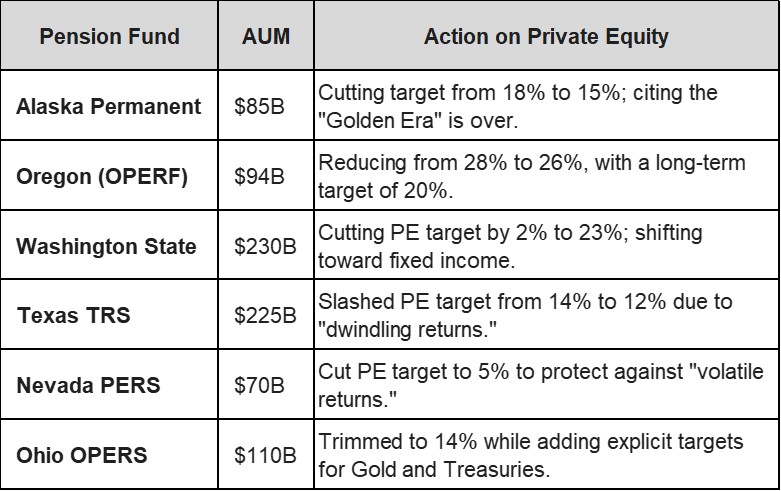
The "Yale Model" has lost its aura. While Wall Street tries to sell these products to retail investors under the guise of "democratization," the more sophisticated state pensions - the better allocators among them - are quietly heading for the exits.
Perhaps the most telling is the University of California’s recent moves. Jagdeep Singh Bachher, UC's CIO has cut hedge funds from 10% to 0% and moved a portion of their assets into ultra-cheap public index funds in a move called "Simplicity Works." The results? UC’s so-called "Blue and Gold" pool - a 100% passive 80/20 portfolio - returned 15.8% in fiscal 2025, outperforming every single one of UC’s complex investment products for the fifth straight year.
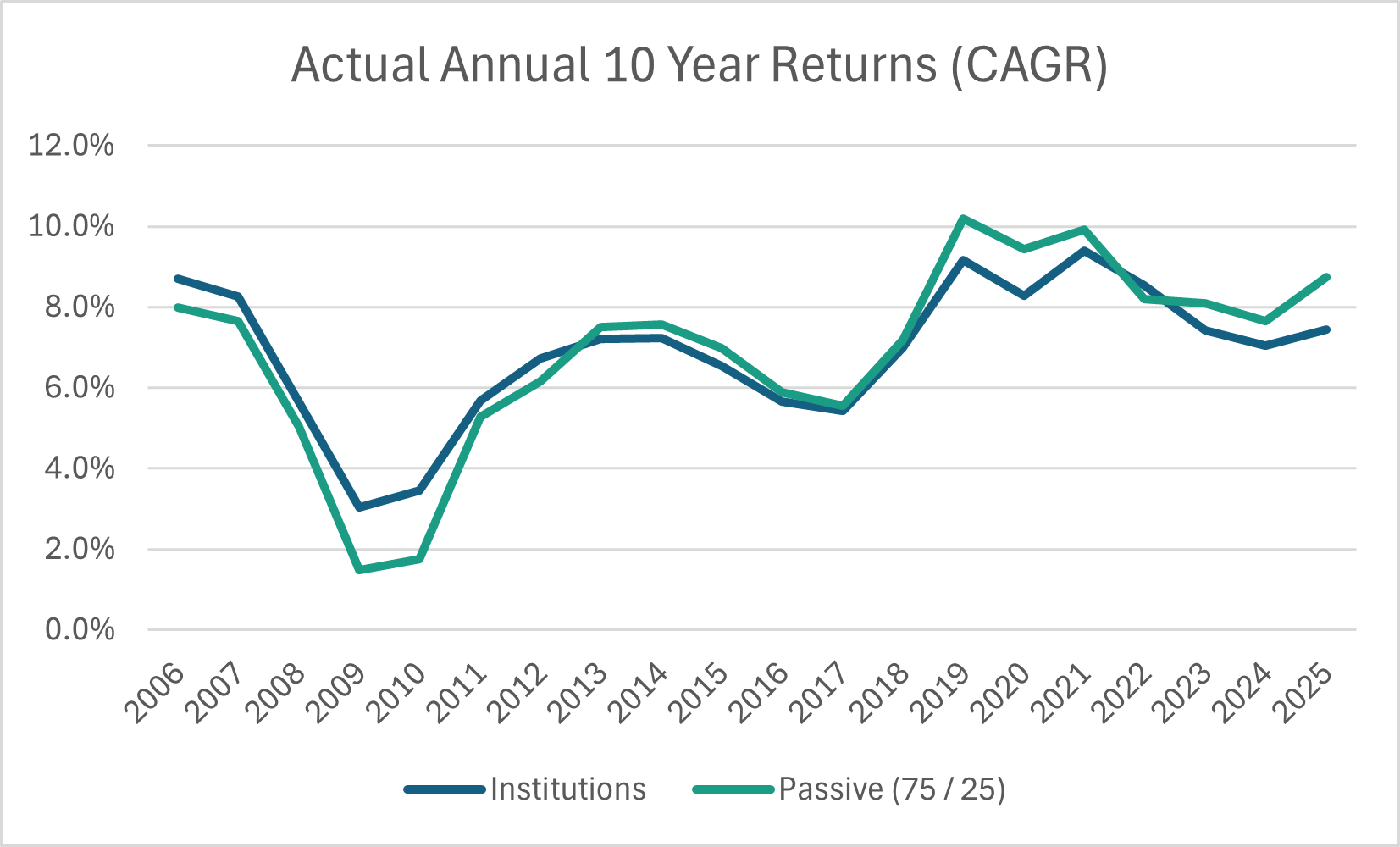
And looking at the chart below you can see that 10 year returns on passive have exceeded institutional returns in 11 of the past 12 years. The "exclusive" stuff is losing to the "boring" stuff.
The Retail Trap
As institutions exit, the "wealth channel" is being flooded with "evergreen" products. Managers launched 41 of these funds in 2025 alone, targeting the $9 trillion 401(k) market.
Why now? Because public market beta has become a cheap commodity. It’s transparent and hard to overcharge for. Private wrappers, however, are opaque, hard to benchmark, and carry performance-fee stacks that are economically richer for the seller - and, often, the person selling them to you.
When the "smart money" hits its capacity limits and starts trimming, you should ask why the big alternative managers and wirehouse wealth managers are so eager to "democratize" these products for you.
The Case for Transparency
You don't need the Yale model. You certainly don't need to pay a premium for the privilege of being locked out of your own money. As Jagdeep Bachher has proven at UC, simplicity isn't just a backup plan - it’s a competitive advantage.
The most "sophisticated" move you can make in 2026 is to own the market cheaply and on purpose. That means public equities, short-term Treasuries, liquid credit, and a diversifier like gold.
When you choose transparency over opacity, you get:
No capital calls.
No quarterly redemption math.
No performance-fee drag.
No "slow-moving marks" pretending to be low risk.
Daily liquidity and transparency.
Wall Street sells exclusivity - the "alpha," the complexity, the velvet rope. People love being part of an exclusive club. But if you want a social status symbol, join a country club. For your money, you need a portfolio that works.
2026 is a loud reminder that patient, boring, and simple strategies aren't just for beginners. They are the proven way to grow your wealth.
ArcVest is a fee-only fiduciary registered investment adviser. This article is for educational purposes and does not constitute personalized investment, tax, or legal advice. Investing involves risk, including the potential loss of principal. Past performance does not guarantee future results.

ArcVest
A fiduciary on your side.


Quick links
Support
Copyright 2026. ArcVest. All rights reserved.