
Articles
High on Financial Fiction
Someone sits you down. Maybe it’s a local wealth manager. Maybe it’s a "finance influencer" you know with a laser-eye profile picture on X.
They lean in. They lower their voice. They tell you about a stock.
Ten minutes later, you’re ready to wire your life savings. You haven’t checked a single balance sheet. You haven’t read a filing. You’re just... ready.
Congratulations. You’ve just been "engineered."
I had a client ask me recently to help them evaluate a company that they had been pitched by a friend. The company is a clear AI beneficiary that may be undervalued today. The story looks great. But the mathematical, probabilistic truth is that investing in this company is highly unlikely to be better than sticking with the market.
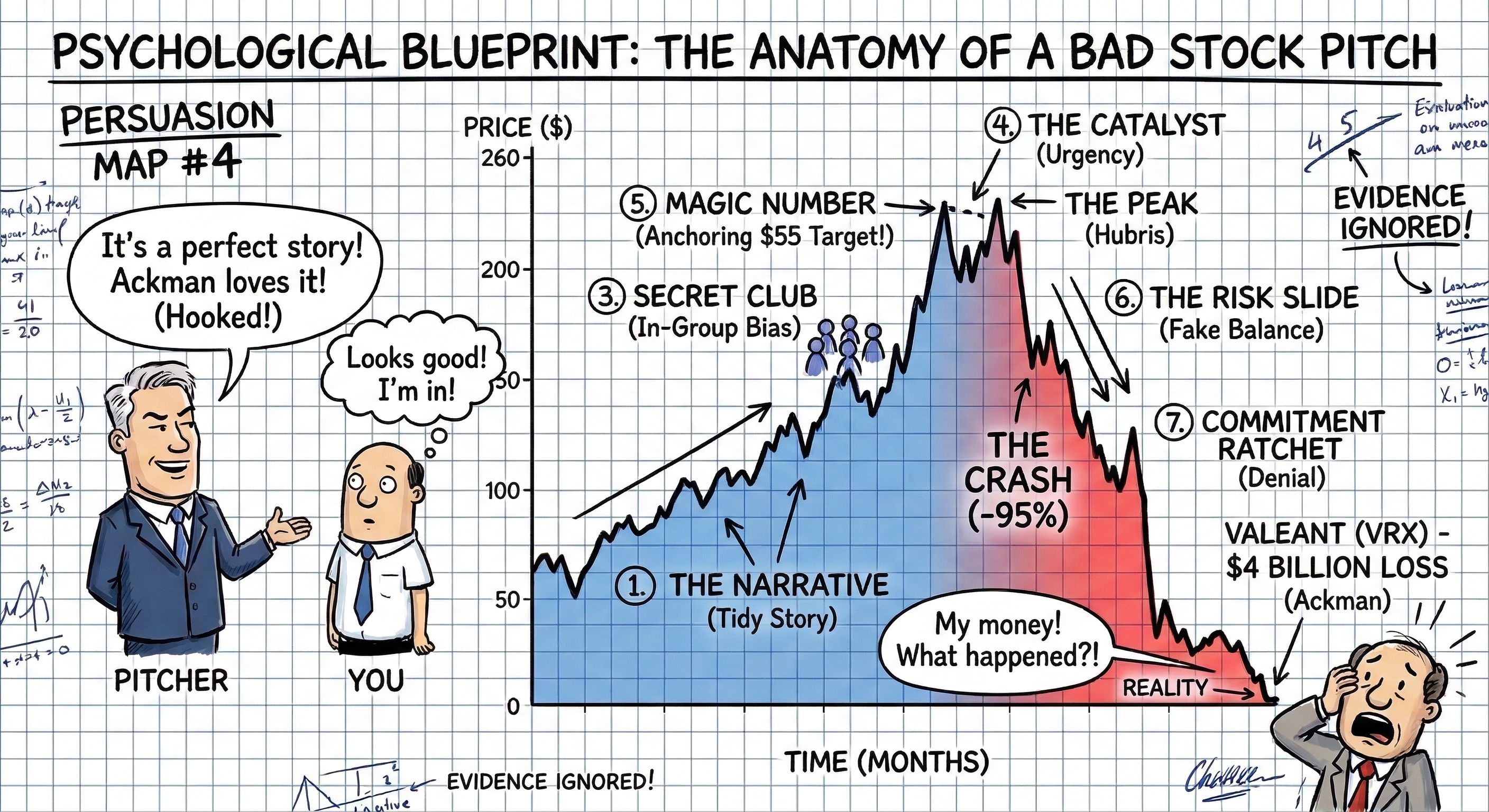
It is important to remember that most stock pitches aren’t financial analysis. They are psychological operations designed to exploit the hardware bugs in your wetware. They are narratives that provide a dopamine hit but mathematically are highly unlikely to help your portfolio. Let's dig in to the anatomy of the trap, so you can avoid falling for it.
1. The "Everything" Narrative
Every great pitch starts with a story, not a spreadsheet.
“The market is punishing this company because of a headline from 2022. But underneath, it’s a butterfly emerging from a cocoon. New CEO. New tech. The world just hasn't noticed yet.”
Your brain loves this. It’s a tidy package that explains the past and promises the future. More importantly, it gives you a starring role: the genius who sees what everyone else missed.
The Bug: Markets are complex, chaotic systems. Stories are simple. To make a story work, you have to ignore 90% of the data. Your brain doesn't care about the missing 90% - it only cares that the remaining 10% rhymes.
2. The Credibility Halo
The pitch never arrives alone. It comes attached to a "Name."
This is the Authority Bias. If a guy who managed a billion-dollar fund tells you a stock is a winner, your brain assumes his expertise in "Managing Money" transfers to "Predicting This Specific Future." It doesn't.
Take Bill Ackman and Valeant Pharmaceuticals. Ackman is a brilliant guy. He pitched Valeant as a revolutionary healthcare model. Investors followed him into the fire because, well, he’s Bill Ackman.
The Result: Pershing Square lost $4 billion. The stock dropped 93%. Ackman later admitted he broke every one of his own rules. The "Expert" didn't just trick the followers; he tricked himself.
3. The "Secret Club" Invite
“Wall Street isn't covering this yet. The institutions can’t buy it because it’s too small.”
This fires off an ancient tribal signal. You’ve been invited into the inner circle. You have "Alpha."
The Reality: In a world of high-frequency trading and AI-driven scanners, "nobody is looking at it" usually means "everyone looked and decided it was garbage." The obscurity isn't a feature; it’s a warning.
4. The Urgency Trap (The Catalyst)
Every pitch needs a "Why Now."
“Earnings are next month. They’re going to crush the estimate.” This triggers Scarcity Bias. The window is closing. If you don’t act now, you’re the loser left at the station. This shifts your brain from "Is this a good business?" to "Can I time this trade?" Spoiler: You can't.
5. The Magic Number (Anchoring)
“The stock is at $30. It’s worth $55. That’s 80% upside.”
Once that $55 hits your brain, you’re toast. This is Anchoring. Every piece of news you read from that point on will be filtered through the lens of: "Does this help us get to $55?"
You stop looking for reasons to sell. You start looking for reasons to be "right."
6. The "Risk" Slide (Fake Balance)
Every professional pitch has a slide at the end labeled "Risks."
“Risk: The CEO is new. Mitigation: She was a rockstar at her last job. Risk: Debt. Mitigation: They just refinanced.”
This isn't due diligence. It’s Inoculation. By raising the risks and immediately "solving" them, the pitcher makes you feel like the downside has been handled. You feel safe because you "considered the risks," even though you only considered the versions the pitcher allowed you to see.
7. The Commitment Ratchet
The best pitchers don't ask you to buy. They ask you to agree.
"Do you agree the market overreacted?" (Sure.)
"Do you agree the product is cool?" (Yeah.)
"Do you agree the debt is manageable?" (Seems like it.)
By the time you get to the conclusion, you’ve already built the house. You aren't buying their idea anymore; you’re buying your idea. And humans hate admitting their own ideas are stupid.
The ArcVest View: Stop Being the Prey
None of this means stock pitches are scams; they just aren't good for your portfolio. Most people pitching them actually believe the hype. That’s what makes them dangerous. The psychology works on them, too.
Smart people - experienced people, billionaires, "experts" - lose money every day because they fell in love with a story.
At ArcVest, we have a different strategy: We don't listen to the stories.
We don't pick "hidden gems."
We don't try to time "catalysts."
We don't bet on "rockstar" CEOs.
We own the market. Broadly. Cheaply. Systematically. It’s not a great story to tell at a dinner party, but it has a much better ending for your bank account.
The next time someone leans in to tell you about a "can't-miss" opportunity, pay attention to your pulse. If you feel smart, included, and excited - run. That’s not an investment. That’s a pitch working exactly as it was designed.
ArcVest is a fee-only fiduciary registered investment adviser. This article is for educational purposes and does not constitute personalized investment, tax, or legal advice. Investing involves risk, including the potential loss of principal. Past performance does not guarantee future results.

ArcVest
A fiduciary on your side.


Quick links
Support
Copyright 2026. ArcVest. All rights reserved.