
Articles
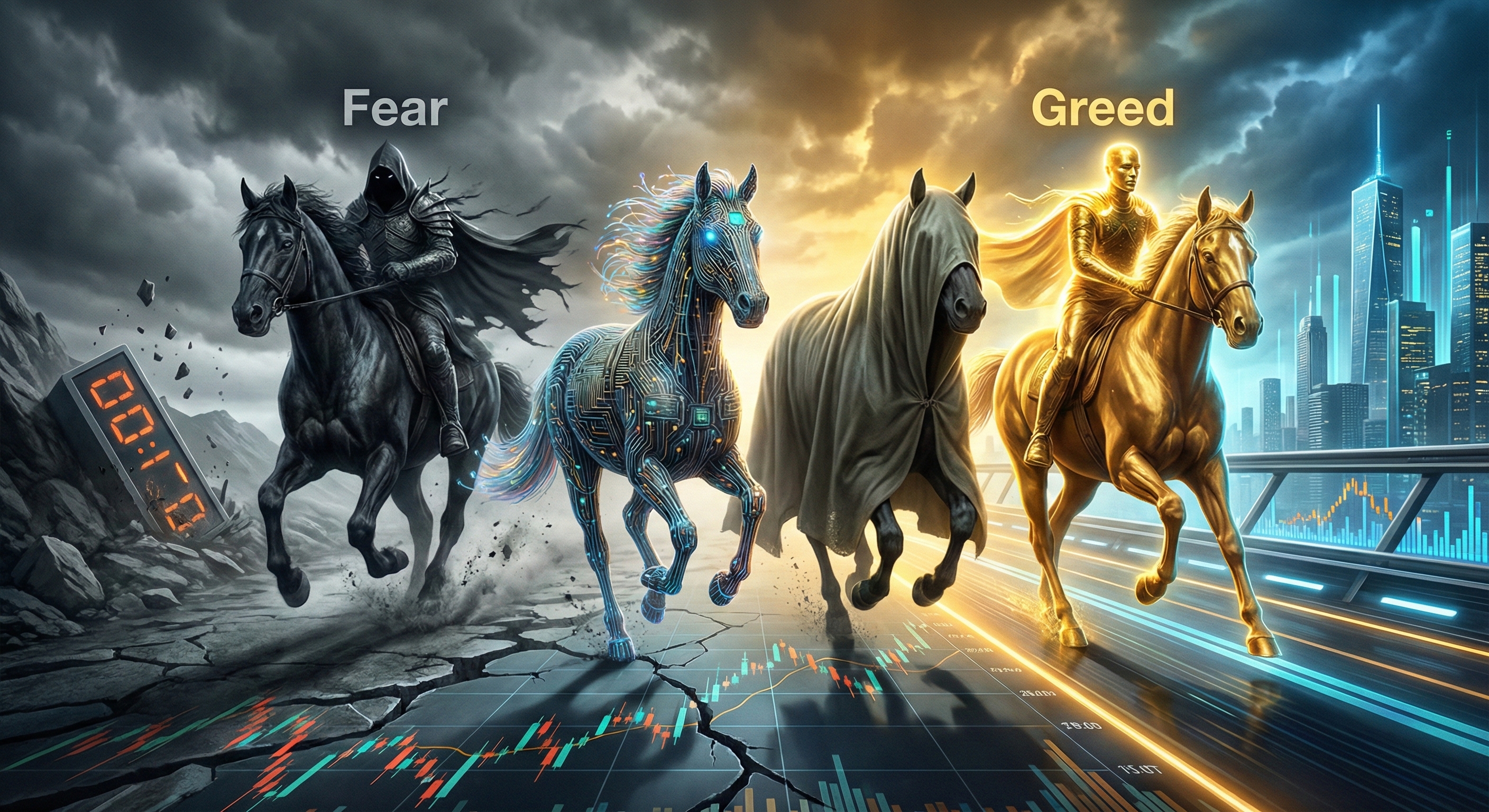
The Four Horses of the AI Market
Funny how my mind wobbles between giddiness and terror in the markets right now.
Half of me is terrified of everything that could go wrong. The other half is extremely greedy for everything that could go right.
Talk to any investor right now, and you hear the same cognitive dissonance.
One minute it’s: “Should I raise cash? What if AI does hollow out all the white-collar jobs?” The next minute it’s: “What if this is the biggest wealth-creation event since the internet, and I’m sitting in T-bills?”
Here is what makes this market cycle even more interesting: Both the fear and the greed are backed by solid companies and hard evidence.
The greed camp points to the most profitable companies in human history generating massive cash flow. There is no Pets.com here. And the AI tools (looking at you Claude Code) are truly amazing.
The fear camp points to an S&P 500 trading at almost 7,000 with a Shiller CAPE ratio above 40. We’ve only seen that once before. It didn't end well.
Both camps are right.
We aren't debating just one outcome. We are watching four radically different futures play out simultaneously. Every portfolio is currently betting on one or more of these four horses.

HORSE ONE — AI Wins Big
This is the full-throated bull case.
AI works at scale. Productivity surges. Margins expand. Abundance is everywhere.
Today, the top 10 stocks make up 40% of the S&P 500. That’s higher than the dot-com peak. But the bulls have a trump card: those 10 companies also generate about 32% of the index's earnings.
The Big Five hyperscalers plan to spend up to $700 billion on AI infrastructure just in 2026. And then likely $1 trillion in 2027 at current expansion rates. These sounds scary as hell. However, if that spending actually translates into automated knowledge work, which could be worth $50 trillion in annual revenue, their current valuations are justified, and they may even be cheap.
Horse One says: Go long the leaders. Concentration is a feature, not a bug.
HORSE TWO — AI is Telecom 2.0
This is the fear case. We’ve seen this movie before.
In the late 1990s, telecom companies spent over $500 billion building fiber-optic networks. The return on that capital was very delayed. WorldCom and Global Crossing went bankrupt. The infrastructure was eventually used, but the pioneers were slaughtered.
Horse Two says the $700 billion AI CapEx overwhelms the actual return on capital. The productivity gains are real but incremental. The narrative shifts from "transformational" to "useful but very overpriced."
If the Mag 7 drops 50%, the S&P 500 drops 17% - even if every other stock stays flat. Following the 2000 peak, large-cap growth fell 57% over eight years while value stocks stayed flat.
Horse Two says: Rotate out. Own what’s cheap.
HORSE THREE — The SaaSpocalypse
This is the one happening right now.
Horse Three says AI wins, but it hollows out the economy, and white collar workers find themselves driving Uber to make ends meet, only to have autonomous driving take those jobs a year later. Citrini did a good bear-porn peice on this over the weekend, and recent moves in SaaS names seem to confirm some kernel of truth here.
The S&P North American software index recently had its worst month since 2008. The iShares software ETF (IGV) is down 23%. Salesforce and Workday are down 40% from their peaks.
Why? Because AI tools are doing the work. If 10 AI agents can replace 100 knowledge workers, you don't need 100 Salesforce seats. You need 10. That is a 90% revenue destruction for the same economic output.
The SaaS "per-seat" business model is under siege. AI doesn't expand the software pie; it concentrates it at the infrastructure layer and hollows out the middle.
Once you see this in software, it's easy to see it across every white-collar function there is - customer service, accounting, finance, coding, sales support, etc.
Wall Street calls the counter-trade "HALO" (Heavy Assets, Low Obsolescence). You buy what AI can’t eat: Energy. Copper. Industrial infrastructure. Hard assets.
Horse Three says: We are living through the destruction part right now. Buy things you can drop on your foot.
HORSE FOUR — The Private Market Illusion
This is the escape hatch. If public markets are a volatile, concentrated mess, just hide in private markets.
Except the math is breaking down.
Private credit is a $3 trillion market, and defaults are climbing. UBS expects defaults to jump 3% this year. But the real stress is hidden. Lenders are quietly restructuring loans and taking "Payment-in-Kind" (PIK) instead of cash. Public BDCs are taking 8% of their income in IOUs. Last week Blue Owl permanently halted redemptions at its non-traded BDC. That is a glaring red flag.
If you are an investor looking at your K-1s and capital call notices, you already know the truth. Private equity cash distributions (DPI) are in the gutter - a fourth year in a row below 15% - worse than ever before. Venture exits are the worst since the financial crisis. Capital is trapped.
The dirty secret of Horse Four is that without special access and priviledge private markets just give you public market risk on a time delay, with a gate on the exit and higher fees.
THE SYSTEM OVER THE GUESS
Most investors feel forced to pick a horse.
Are you buying the Mag 7? Rotating to value and cash? Hiding in hard assets? Locking up capital in alts?
Choosing a horse is the biggest risk you can take right now. You are betting on narratives, none of which can be reliably timed.
The alternative is discipline. You build a system that survives all four.
Own U.S. large caps. If Horse One wins, you participate.
Own mid-caps, small-caps, and international. If Horse Two wins, you catch the mean reversion.
Own hard assets (gold and whole sectors of the S&P 500). If Horse Three wins, you have a store of value while white-collar margins collapse.
Hold short-term T-bills. Currently yielding around 3.6%. This isn't an investment; it’s dry powder.
If markets drop 40%, your T-bills don't. You rebalance mechanically. You buy cheap assets while everyone else panics.
You don't have to predict the future. You just have to build a portfolio that survives it.
ArcVest is a fee-only fiduciary registered investment adviser (RIA). This commentary is for informational purposes only and is not individualized investment, legal, or tax advice. All investing involves risk, including loss of principal.

ArcVest
A fiduciary on your side.


Quick links
Support
Copyright 2026. ArcVest. All rights reserved.